
# Custom Wrapping Paper: Sheet Sizes, GSM, Print Methods and Order Planning
Printed wrapping paper is the one branded surface a customer deliberately tears. Ordered by the sheet, it is specified like any other custom packaging: a sheet size, a paper weight, a print method and a run length — and the same quote-comparison discipline applies.
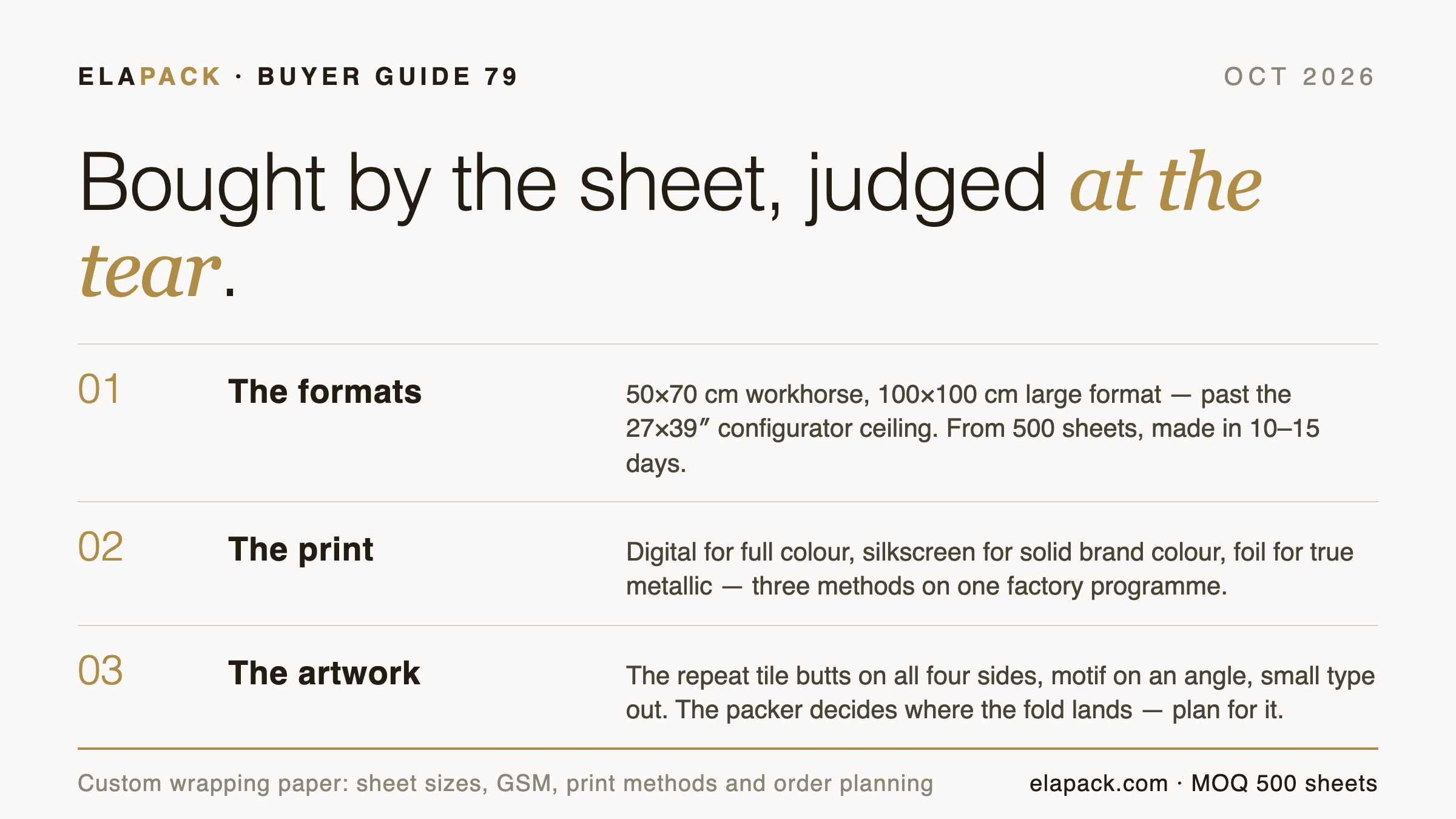
This guide covers the buying side of custom wrapping paper for brands: how the market sells it (sheets versus rolls, print-on-demand versus factory runs), which sizes and weights fit which gifts, what foil stamping and silkscreen add over the digital printing most US shops offer, and how to plan the artwork and the order window. We print wrapping paper by the sheet at our factory, so where our own terms are relevant they are stated plainly: two sheet formats, 50 by 70 centimetres and 100 by 100 centimetres, from 500 sheets, produced in 10–15 days.
Key takeaways
Custom wrapping paper is bought by the sheet or by the roll, and four decisions drive the price: sheet size, paper weight, print method and run length.
- ELAPACK prints wrapping paper by the sheet in 50×70 cm and 100×100 cm formats, from 500 sheets, produced in 10–15 days.
- US configurators top out near 27×39 inch sheets in digital print only; factory sheet programmes reach larger formats with foil or silkscreen.
- Foil stamping and metallic spot ink are different processes, and a foil-decorated sheet generally cannot be recycled curbside.
- Per-sheet price falls fastest between 100 and 1,000 sheets; above that, the savings flatten.
Last updated October 2026.
What custom wrapping paper actually is
Custom wrapping paper is paper printed to your artwork — a repeating logo pattern, a seasonal illustration, a monogram grid — as opposed to stock retail wrap. The custom part means three things, and each one is a decision line on the quotation:
- Your repeat pattern, printed edge to edge. The artwork tiles across the sheet so any fold shows the brand, not a blank gap. That tiling rule is stricter than it sounds, and it constrains the design (more on this in the artwork section).
- A specified sheet, not “whatever size arrives”. Sheet dimensions, paper weight and print method are all chosen, and all three move the unit price.
- A run length that fits your programme. A one-season holiday wrap and a year-round retail counter wrap are different quantities, and the honest answer is that they suit different suppliers.
It is worth separating wrapping paper from its lighter cousin at the start, because the two appear side by side in every supplier catalogue and serve different jobs. Tissue paper — 17 to 30 gsm in published listings — is a soft inner wrap that cushions and fills; wrapping paper is a heavier printed sheet whose job is appearance at the moment of unwrapping. Our tissue paper guide covers the inner layer; this article is about the printed sheet outside it.
Sheet or roll: how the market actually sells custom wrap
Two sales models dominate, and knowing which one you are talking to explains most of what you will see in quotes.
Print-on-demand and configurator shops sell small quantities through a web flow. Packlane, the best-known packaging configurator, lists wrapping paper in seven sheet sizes from 6×6 inches up to 27×39 inches, plus rolls in a fixed 29-inch width and lengths from 84 to 420 inches — all on a single 50 lb paper stock, printed digital CMYK on the front only, from as few as 25 sheets. StationeryHQ, a print-on-demand specialist since 2014 with plants in California and Kentucky, sells 20×29 inch sheets on 70 lb opaque or gloss stock, full-colour digital, with 72-hour production and wholesale pricing visible after login. These shops are built for designers and small brands: low entry, instant pricing, fast turnaround, one stock, one print process.
Factories and wholesale converters quote from a specification instead of a configurator. The entry quantity is higher — our minimum order for wrapping paper is 500 sheets per design — the sheet formats reach larger areas, and the print menu is wider than digital alone: silkscreen for solid spot colour, foil stamping for true metallic, digital for full-colour art. StationeryHQ’s own pricing structure makes the boundary visible: retail-per-sheet pricing in the open store, wholesale terms behind an account. Superior Gift Wrap, which has served the wholesale trade for over 25 years, sells its custom print programme the same way — through subcategory enquiry rather than a price button.
Neither lane is better in the abstract. The configurator wins a 50-sheet test run of a one-event design; the factory wins a branded wrap programme measured in hundreds of sheets with finishes a digital-only shop cannot print. The mistake to avoid is comparing a 25-sheet configurator price against a 500-sheet factory quote and reading the difference as markup — it is two different products at two different run lengths.
What size should wrapping paper sheets be?
Sheet size is the first specification to lock, because it decides what the paper can wrap and how much of it becomes waste. The two formats we print are deliberately far apart:
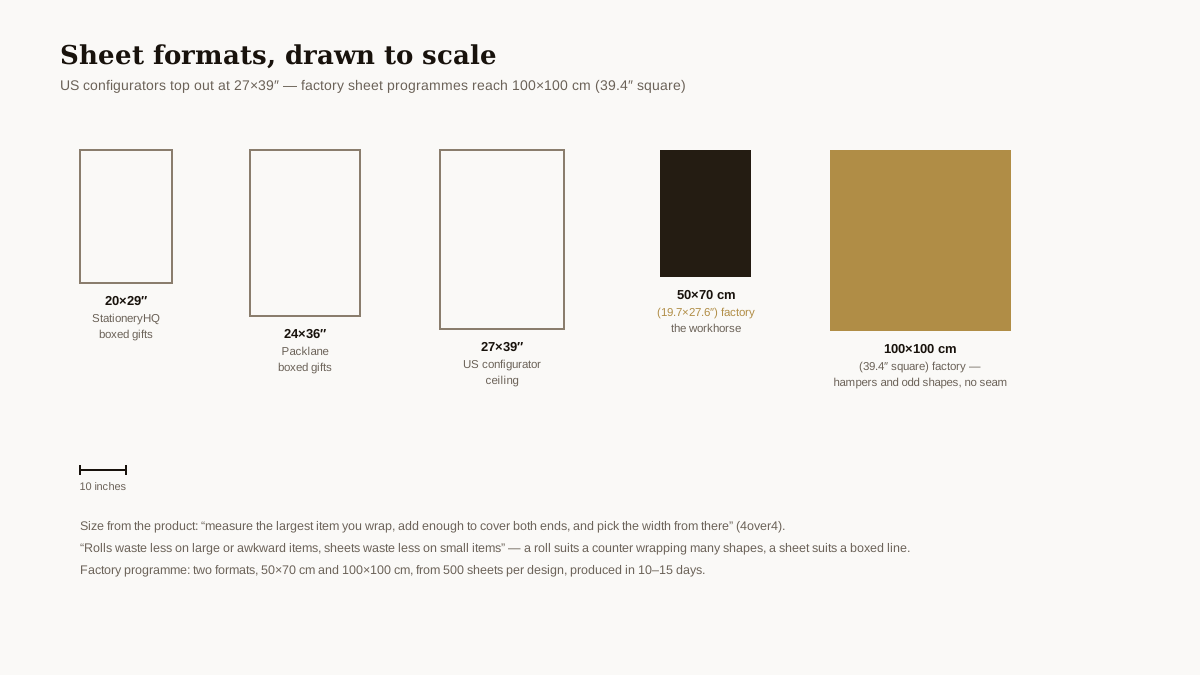
- 50×70 cm (19.7×27.6 inches) — the workhorse. Comparable to the largest US standard sheets (StationeryHQ’s 20×29, Packlane’s 24×36) and large enough to wrap a shirt box, a stacked apparel set or a standard rigid gift box in one piece.
- 100×100 cm (39.4×39.4 inches) — the large format. Bigger than any sheet in the US configurator line-ups, which top out at 27×39. A square metre of printed wrap covers a large or awkward gift in one sheet — the case 4over4 makes for its largest tissue format, “covers a boxed gift or cuts down into smaller pieces” — or serves a retail counter where staff cut wrap to size all day. Cutting yield from one large sheet usually beats taping two small ones, on both labour and appearance.
A quick reference against the published US sizes: 20×29 and 24×36 suit boxed gifts; 27×39 handles larger presentation boxes; a 39-inch square handles those plus odd shapes — gift sets, hampers, oversized apparel boxes — without a seam. If your products are mostly one size, size the sheet to that product with margin for the fold, not to a catalogue default. Two working rules from 4over4 complete the method: size from the product — “measure the largest item you wrap, add enough to cover both ends, and pick the width from there” — and pick the format by the gift mix, because “rolls waste less on large or awkward items, sheets waste less on small items”: a roll programme suits a counter wrapping many shapes, a fixed sheet suits a boxed product line.
How much does custom wrapping paper cost?
Per-sheet pricing, as published by 4over4 for a 10×15 inch tissue sheet, runs from $1.26 per sheet at 100 sheets to about $0.80 at 2,000 — with, in their words, “most of the saving sits in the step from 100 to 1,000 sheets”. That curve shape is the useful part, because it holds across the market regardless of the absolute numbers: the first hundred sheets carry the set-up, and the price per sheet flattens as the run lengthens.
What moves the absolute number, in rough order:
- Sheet size. Price tracks paper area. Doubling the sheet roughly doubles the paper and ink in each unit.
- Paper weight and stock. Heavier and coated stocks cost more per square metre. The unit split trips more buyers than the numbers do: US shops quote basis weight in pounds (50 lb, 70 lb), factories usually quote grams per square metre (gsm). The published conversion — “1 lb Text = 1.48 gsm and 1 lb Cover = 2.708 gsm” — puts Packlane’s 50 lb sheet at about 75 gsm and StationeryHQ’s 70 lb at about 105 gsm, and the category matters as much as the number: 50 lb cover multiplies out to roughly 135 gsm, nearly double its text-weight namesake. 4over4’s tissue listings print both scales side by side (10 lb / 17 gsm, 18 lb / 30 gsm) — the transparent habit worth asking any supplier for. Confirm the scale and the category before comparing two quotes.
- Print method and coverage. Full-coverage digital costs more than a one-colour silkscreen logo grid; two-sided printing, where offered, costs more again.
- Finish. Foil stamping adds a pass and a plate; on 4over4’s published tissue pricing, even switching stock to black adds 20 percent to the run, which indicates how sensitive short-run pricing is to any specification change.
- Quantity. The step from hundreds to thousands is where the unit price drops fastest.
Our own wrapping paper is quoted rather than priced on a page — send the sheet format, the artwork intent and the run length, and a quotation comes back within one business day. The honest trade: no instant configurator price, in exchange for factory pricing at 500 sheets and up and print methods the digital-only shops do not offer.
Which print method should branded wrapping paper use?
Most US print-on-demand wrap is digital CMYK, because digital needs no plates and prices short runs well. But digital is one of three methods that matter for wrapping paper, and the choice follows the artwork:
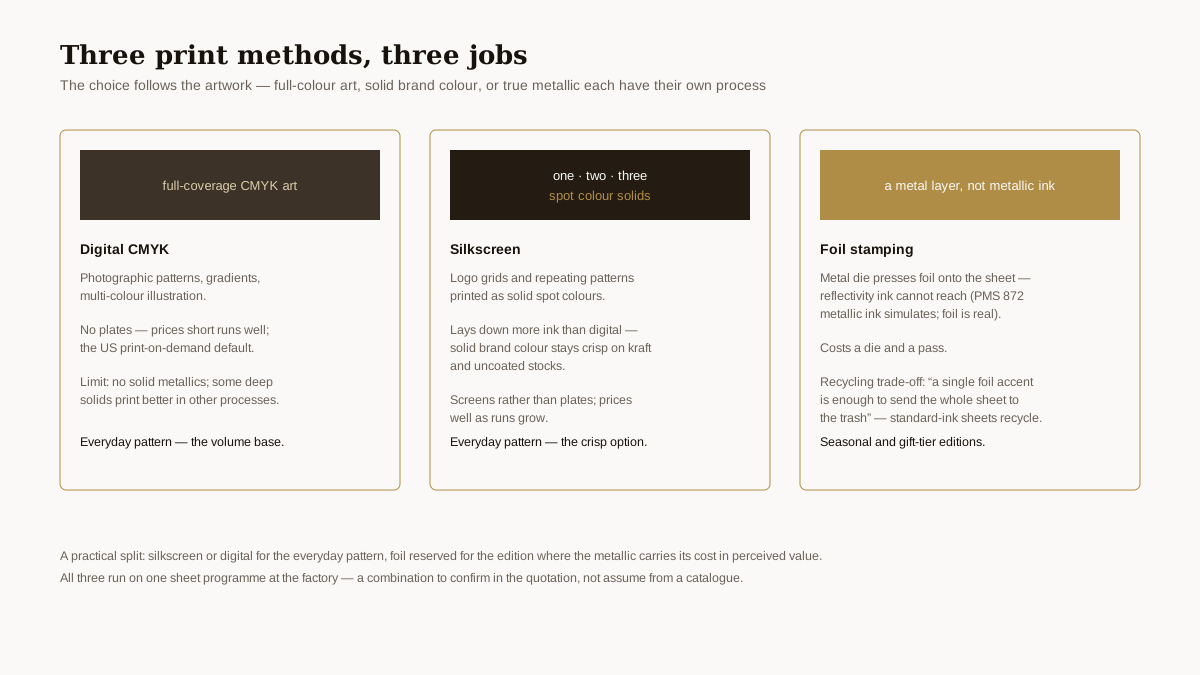
- Digital CMYK for full-colour art — photographic patterns, gradients, multi-colour illustrations. Best unit economics at short runs; the constraint is what it cannot do: solid metallics and some deep solid colours print better in other processes.
- Silkscreen for spot-colour logos and patterns — one, two, three colours printed as solids. Silkscreen lays down more ink than digital, which is why solid brand colours and clean logo grids look crisper on kraft and uncoated stocks. It needs screens rather than plates, suits repeating patterns naturally, and prices well as runs grow.
- Foil stamping for true metallic — a metal-die process pressing foil onto the sheet, not metallic ink. The distinction is real, not pedantic: 4over4’s tissue line offers metallic spot inks (PMS Metallic Gold 872, Metallic Silver 877 among them), which simulate gold in ink; foil is an actual metal layer, with the reflectivity ink cannot reach. Foil costs a die and a pass, and the same supplier’s recycling note applies to any foil-decorated sheet: “a single foil accent is enough to send the whole sheet to the trash” — uncoated paper printed with standard inks recycles curbside in most programmes, foil-decorated wrap generally does not. The same decoration processes behave differently on box surfaces; our surface finishes guide compares them there.
A practical split many brands land on: silkscreen or digital for the everyday pattern, foil reserved for the seasonal or gift-tier edition where the metallic carries its cost in perceived value. Both can run on the same sheet programme at our factory, which is exactly the kind of thing to confirm in a quotation rather than assume from a catalogue.
Where can you get custom wrapping paper printed?
Three lanes, matched to three situations:
- Print-on-demand shops (StationeryHQ and similar) for tens of sheets, full colour, needed in days. 72-hour production windows suit launches, prototypes and one-off events.
- Configurator packaging shops (Packlane and similar) for small branded runs through a self-serve flow — instant pricing, one stock, one print method, production measured in one to three weeks.
- Factories (ours and comparable) for programmes from 500 sheets: larger sheet formats, silkscreen and foil alongside digital, factory pricing at volume, and a quotation cycle measured in hours rather than a configurator measured in clicks.
The lane choice is a quantity-and-finish question, not a quality question. What the factory lane adds is not “better printing” but capability digital-only shops do not list, and a unit price that keeps falling as the programme grows.
Designing artwork for sheet printing
The rules that decide whether a printed pattern looks intentional or accidental are mostly rules for the repeat pattern and its margins, and the best published summary of them is on 4over4’s own guide:
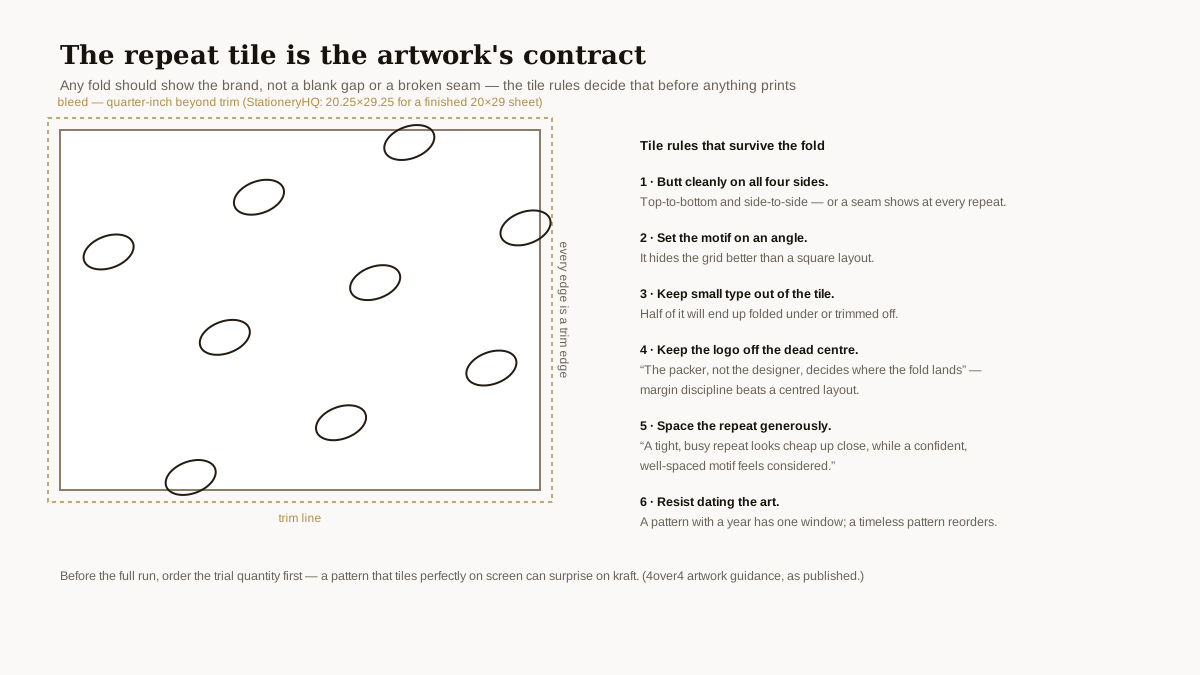
- The repeat tile must butt cleanly on all four sides — top to bottom and side to side — or a seam shows at every repeat.
- Set the motif on an angle; it hides the grid better than a square layout.
- Keep small type out of the tile. Half of it will end up folded under or trimmed off.
- Keep the logo off the dead centre of the sheet, where the fold lands — and remember that “the packer, not the designer, decides where the fold lands and where the roll gets cut”, so margin discipline beats a centred layout.
- Resist dating the art. A pattern carrying a year or a single seasonal motif “has one window”; a timeless pattern sells through and reorders.
- Watch the repeat density: “a tight, busy repeat looks cheap up close, while a confident, well-spaced motif feels considered” — spacing is a quality signal, not just taste.
Then add the mechanical margins: StationeryHQ asks for a quarter-inch of bleed beyond trim (art at 20.25×29.25 for a finished 20×29 sheet), and the same logic applies at any size — ask for the bleed and safe-zone specification before building the file. And before the full run, do what experienced buyers do and what 4over4 recommends outright: order the trial quantity first to check colour and repeat on the real stock. A pattern that tiles perfectly on screen can surprise on kraft.
The ordering timeline for branded wrap
Our wrapping paper runs 10–15 days from confirmed specification — faster than our box lines (15–20 days), because a printed sheet is a simpler product than a folded box: no dieline tooling, no structural assembly. Plan backwards from when the wrap needs to be at the packing table, not from when the holiday falls: artwork approval, production, and transit have to fit inside the window, and Q4 compresses all three. Our Christmas packaging timeline walks the full backwards calendar for seasonal programmes — the short version is that holiday wrap artwork frozen in September ships calmly in November. Buffer the delivery leg as well as the production leg: 4over4’s planning rule is having stock “in the building, a clear week earlier so a delivery problem is survivable” — a week of slack turns a late truck from a crisis into a footnote.
One scheduling note specific to wrap: because a timeless pattern does not expire, the reorder decision is inventory, not urgency. Brands that plan wrap as a stocked item — reordering at a reorder point rather than at a deadline — buy at normal lead times all year and skip the peak-season premium entirely.
When a 500-sheet minimum is the right lane
A 500-sheet minimum order is the honest boundary between the two markets, so it deserves a direct answer rather than a dodge. Five hundred sheets is right when:
- The wrap carries the brand for a season or longer, not a single event.
- The pattern is timeless enough to sell through (see the artwork rules above).
- The sheet format or finish needed — a 39-inch square, foil, silkscreen solids — is not available in the print-on-demand line-ups.
- The per-wrap maths matters: at programme volumes, factory sheet pricing plus one large format that cuts down beats repeated small-run orders of a smaller sheet.
It is the wrong lane for a 50-sheet test, and saying so plainly is cheaper for everyone than an order that sits in storage. Test small wherever that is possible, then move the programme to the factory once the pattern, colour and sheet size are proven.
Sources
- Packlane — Custom Wrapping Paper — https://packlane.com/products/wrapping-paper
- StationeryHQ — Wrapping Paper Sheets — https://www.stationeryhq.com/products/wrapping-paper-sheets
- 4over4 — Custom Wrapping Paper: Print Your Own Branded Gift Wrap — https://www.4over4.com/article/custom-wrapping-paper-print-your-own-branded-gift-wrap
- Superior Gift Wrap — Custom Printing — https://www.superiorgiftwrap.com/store/custom_print.html
- Soloprinting — Paper Weight Conversions — https://soloprinting.com/resources/paper-weight-conversions
Frequently asked questions
How much does custom wrapping paper cost?
Published per-sheet pricing runs from $1.26 at 100 sheets down to roughly $0.80 at 2,000 for a small (10×15 inch) tissue sheet, with the steepest savings between 100 and 1,000 sheets. Larger sheets, heavier stock, full coverage and foil all add to the unit price. Factory programmes such as ours are quoted on specification — sheet format, print method, quantity — with a quotation returned within one business day.
Where can I get custom wrapping paper printed?
Three lanes: print-on-demand shops for tens of full-colour sheets in days; configurator packaging shops for small branded runs at instant prices; and factories — including ours — for runs from 500 sheets with larger sheet formats and silkscreen or foil alongside digital. Pick by quantity and finish, not by quality claims.
Where can I buy custom wrapping paper wholesale?
Two wholesale models exist. US distributors and print-on-demand printers (StationeryHQ, Superior Gift Wrap) run account-based wholesale programmes with pricing behind a login. Factories sell wholesale direct: our programme starts at 500 sheets per design with factory pricing from that first wholesale tier. The account model suits mixed retail reorders; the factory model suits a branded wrap programme in volume.
Can custom wrapping paper have foil stamping?
Yes — foil stamping presses an actual metal layer onto the sheet with a die, which is distinct from the metallic spot inks (such as PMS Gold 872) that simulate gold in ink. Foil suits seasonal and gift-tier editions; note the recycling trade-off, since a foil-decorated sheet generally cannot go into curbside paper recycling, while uncoated sheets printed with standard inks usually can.
What is the difference between wrapping paper and tissue paper?
Weight and job. Tissue is a 17–30 gsm soft sheet that cushions and fills inside the box; wrapping paper is a heavier printed sheet whose job is the branded appearance at unwrapping. Most branded gift programmes use both, and our tissue paper guide covers the inner layer separately.
How long does custom wrapping paper take to produce?
Factory production of printed wrap runs shorter than boxes: ours is 10–15 days from confirmed specification. Print-on-demand shops advertise 72-hour production (production timing, not delivery), and configurator shops publish production windows of roughly one to three weeks. Peak season lengthens every lane; seasonal wrap should be ordered on a backwards calendar, not forwards from the deadline.
---
ELAPACK prints custom wrapping paper by the sheet — 50×70 cm and 100×100 cm formats, silkscreen, digital and foil, from 500 sheets in 10–15 days. [Send the artwork and run length for a quotation within one business day](https://elapack.com/contact/).