Production-stage timings from named packaging suppliers are industry references as published by those suppliers and are cited inline; they are not ELAPACK’s quoted schedule for a specific order. ELAPACK’s confirmed trade terms — MOQ 200 pieces, custom sample USD 30 plus USD 25 shipping with 3–5 day sample making, production typically 15–20 days after sample approval and payment receipt, free digital dieline previews, a holiday timeline and feasibility audit returned within one business day, and free storage of split-run balances for up to three months — apply as stated.
A Christmas packaging order does not fail in December. It fails in October, when the enquiry that would have fit the timeline was never sent. This page works the timeline the other way around: from the date your boxes must be shelf-ready, back through production, sample approval and freight, to the date the enquiry needs to leave your desk.
Key takeaways
A Christmas packaging order is decided in October, not December — work backwards from the shelf-ready date through freight, production and sample approval to the date the enquiry has to leave your desk.
- The anchor is the shelf-ready date, not Christmas Day; the last day your own team is in the office is a separate internal deadline.
- Published supplier figures cited on this page put custom printed Christmas boxes in the warehouse before mid-November, with the season starting around October and peaking after Black Friday.
- ELAPACK's confirmed terms are MOQ 200 pieces, a custom sample at USD 30 plus USD 25 shipping made in 3–5 days, and production typically 15–20 days after sample approval and payment receipt.
- Past the enquiry window the honest options are simpler structures and stock formats, or splitting the run between air and sea.
Quick answer: a custom gift box run needs a sample round (3–5 days making), your approval, production of typically 15–20 days, and freight on top. Working back from a mid-November shelf-ready date, the full-custom enquiry window closes around the end of October to the first days of November. Past that point the honest options narrow to simpler structures and stock formats — or rescuing the launch date with a first delivery by air and the balance on the water.
What date should a Christmas packaging timeline start from?
Christmas Day is the wrong anchor. Packaging for the holiday trade is needed weeks earlier, and three earlier dates do the real work.
The first is your on-shelf or launch date: the day gift sets must be packed and visible. The second is your last order-ship date — the day you stop sending orders to customers before carrier cutoffs bite. The third is internal: the last day your own team is in the office to receive, check and pack stock. Monday Merch’s deadline guide makes the point bluntly for branded merchandise: the date that matters is the last day your people are in the office, not the holiday itself.
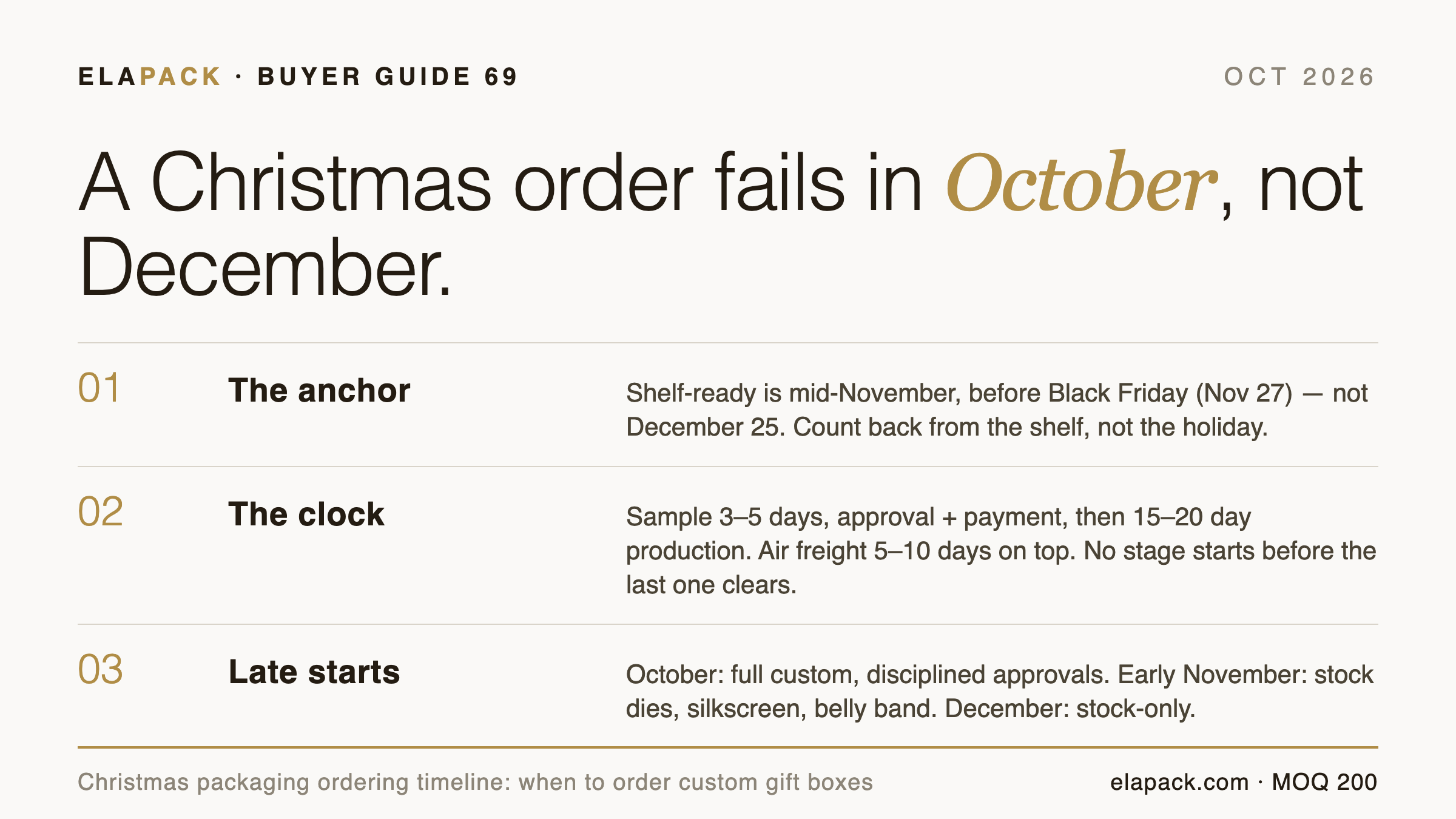
The season also starts earlier than instinct suggests. Emenac Packaging’s US lead-time guide notes that Christmas selling starts around October and peaks after Black Friday — which its page dates to November 27 this year — and that custom printed Christmas boxes “must be in your warehouse before mid-November,” delivered, test-packed and ready. If your plan had boxes arriving in early December “for Christmas,” the plan was already a month late for the season that pays for them.
Write the three dates down before anything else. Every stage that follows is arithmetic against the earliest of them.
What are the five stages between enquiry and delivery?
A custom box order is not one lead time; it is a chain of them, and each handover only starts when the previous one is accepted.
Stage 1 — enquiry and dieline. You send dimensions, quantities and artwork status; the factory returns structure proposals. ELAPACK provides digital dieline previews free at this stage, so structure can be settled on screen before anything physical is made.
Stage 2 — the sample. A custom sample costs USD 30 plus USD 25 shipping and takes 3–5 days to make. Industry stage tables run in the same order: Emenac’s guide budgets dieline and artwork preparation at 2–5 business days, digital proof and approval at 1–3, and an optional sample at 5–10.
Stage 3 — approval. This is the hinge. At ELAPACK, production is counted from sample approval and payment receipt — not from the first email. Run the stage on a 24-hour rule through the fourth quarter: every decision the factory is waiting on — dieline confirmation, sample approval, shipment release — is turned around within 24 hours of landing. An approval that sits in an inbox for a week is a week of production window burned with nothing to show for it.
Stage 4 — production. ELAPACK’s production typically runs 15–20 days. Published industry figures bracket this: Emenac budgets 10–15 business days for printing, die-cutting and finishing plus 1–3 for quality check and packing; Package Supply’s seasonal guide gives custom printed boxes 2–3 weeks (its printed containers and in-mold labelled runs run 6–10 weeks — a warning if your “packaging” includes rigid plastic). Build a Box tells its customers to plan 12–15 days proof-to-door in peak season rather than the standard 7–10. Plan on the fuller end of every range in Q4; hope is not a stage.
Stage 5 — freight and transit. Shipping time is separate from production and depends on mode and destination. Emenac publishes overseas air freight at 5–10 days and sea freight at 4–6 weeks; domestic US ground runs 3–7 days. Mode choice is a deadline decision, and two sections below work it through.
What does a worked backward timeline look like?
Take the mid-November shelf-ready anchor from Emenac’s guide and run the arithmetic backwards with ELAPACK’s terms.
| Milestone | Working back |
|---|---|
| Shelf-ready / in warehouse | mid-November |
| Freight landed (air, overseas) | order ships by very early November (5–10 days as published) |
| Production complete | production must start around the first week of October’s tail — 15–20 days earlier |
| Sample approved + payment | a few days before that — realistically late September to early October for a clean run |
| Enquiry + dieline + sample making | the enquiry belongs in the second half of September |
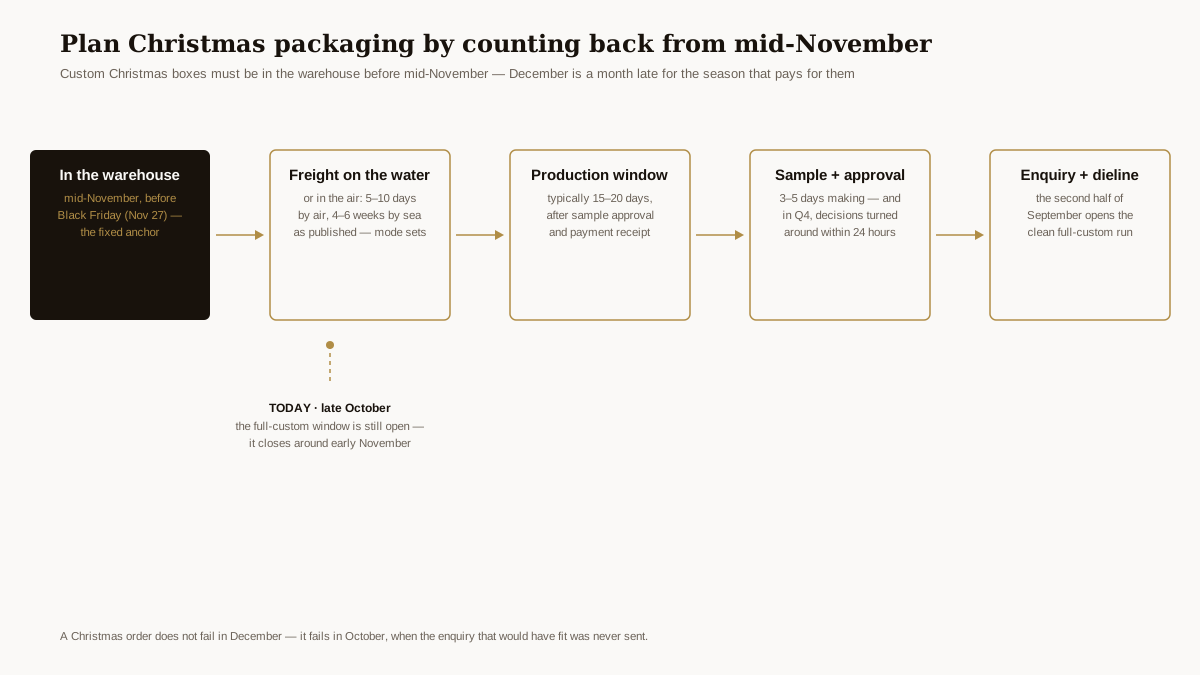
Read at the end of October, the honest conclusion: a full-custom run is still possible but the margin is one delayed approval deep. PakFactory’s holiday guide gives the same cut from the other direction — place Christmas orders by early November at the latest. Monday Merch’s deadline bands describe what remains after that: October leaves roughly 95% of options, early November is the last call for semi-custom, from the third week of November only standard and pre-made formats are realistic, and December is stock-only — “if it is not packed already, it will not make it.”
Sea freight exits the whole-run picture even earlier: at 4–6 weeks as published, a sea shipment for Christmas needed to leave around the start of October. From November onward, no mode but air can carry the entire run — though a late-October dispatch can still put the balance on the water, which section 5 works through.
Where you are right now: the season’s triage matrix
The bands above collapse into one honest table. Find your row; the row to its top is the window you missed, and the row below is what it still costs to save.
| If today falls in… | What still fits | The constraint to manage |
|---|---|---|
| September | Full custom — every structure, finish and freight mode, sea included for the whole run | None; this is the clean window |
| October | Full custom with disciplined approvals; first delivery by air, balance by sea | Production must start within the first two weeks; the 24-hour approval rule is not optional |
| Early November | Semi-custom: structures drawn from our existing die library, faster decoration (silkscreen on the box, a printed belly band); an Air+Sea split is still workable for larger runs | The full-custom window closes as the month opens; the air wave protects the launch, the sea balance lands after the season for restocks |
| Mid-November | Stock formats with branding applied — labels, belly bands | Production lead time no longer fits before the season |
| December | Stock-only — or shift the occasion to a January New Year pack | “If it is not packed already, it will not make it” (Monday Merch) |
Two of the moves in that table deserve a closer look, because they preserve more brand than buyers expect.
Simplify the build. Every finishing pass — foil, emboss, window die-outs — adds a handling step in the busiest quarter. A plain-wrap rigid box with a printed belly band carries the brand in one pass. On magnetic-closure gift boxes the pairing is a standard festive format — MOQ and quote fields for that structure are in the magnetic gift boxes wholesale guide. A satin ribbon tie is the other standard festive pairing — structure and sample terms for that build are on the luxury gift boxes with ribbon page. Silkscreen prints directly onto the box wrap and skips decoration routes that stack lamination and curing time. A black-core greyboard build shows a clean black edge and box mouth with no separate lining pass at all. (One caution from the published figures: 4over4’s tissue runs to 18 days after proof approval — non-box items are not automatically the fast option.)
Fall back to stock formats with branding applied elsewhere. Package Supply names the category fallback: stock packaging paired with separately applied labels. You lose the fitted structure and the wrap printing; you keep the date.
What does not work is compressing sample approval. Production starts after approval and payment — an approval skipped is not a stage removed, it is a dispute deferred to delivery day.
Split the run between air and sea — sized by the horizon, not a percentage
For a run big enough that air freight on the whole order hurts, the rescue is not “ship 20% by air.” It is sizing the first delivery by the horizon it has to cover, which is the method we published in full in How to Plan Split-Packaging Shipments.
Count what the first delivery genuinely must serve — launch quantities, pre-orders, seeding kits, the first weeks of sell-through until the balance can clear receiving — and put exactly that on air. The balance travels by ocean at a fraction of the per-unit freight: 30–40 days door-to-door China–US as quoted in that guide, so a late-October dispatch still lands in time for December restocks. And the balance does not need to ship when production ends: split-run balances are stored free of charge for up to three months and released in waves as your sell-through dictates.
The arithmetic scales without changing: a 5,000-piece boutique gift set and a 50,000-unit corporate run both split by the horizon their first delivery must cover — only the numbers move. When the second run is ready, the reorder version checklist is the working document.
Why does every stage stretch in the fourth quarter?
Q4 is the season where every number in the chain degrades at once. Emenac’s guide is direct: the fourth quarter is the busiest time “for almost everything, whether it’s printing, artwork, or shippers.” Bulk runs — cost-effective, but longer — stack into the same calendar weeks. Specialty boards can run short during holiday demand. Build a Box’s planning figure moves from 7–10 business days to 12–15 in peak, roughly half as long again. Category specifics stack on top of the season — fragrance-led gift sets, for instance, carry their own structures and insert requirements, covered in the wholesale perfume boxes guide.
Freight degrades too: carrier cutoff dates for guaranteed pre-Christmas delivery tighten through December, and Emenac’s December advice to “watch carrier cutoffs” applies even to goods that shipped on time.
The practical response is to put buffer where the handovers are: one extra week around artwork approval, one around freight. Package Supply’s guide frames the whole discipline in one line — start from the date you need packaging in hand, then work backward — and its six-item list (on-sale date, in-hand date, sizes, quantities, artwork readiness, delivery address) is a fair checklist for any seasonal enquiry.
The enquiry that keeps a Christmas timeline honest
A seasonal enquiry that protects its own timeline states six things up front: the shelf-ready date; the quantities per SKU; the product dimensions (length × width × height); whether artwork is final or draft; the sample decision (which structure, and who approves); and the shipping mode and destination against the forwarder’s published holiday cutoffs.
With those stated, you do not have to run the backward arithmetic alone. Send the six lines and our packaging engineers return a Free Holiday Timeline & Feasibility Audit within one business day: which structure fits the window that remains, where the risk weeks sit, and what an air-first split would cost against your dates.
Sources
- Emenac Packaging — US lead-time guide, as cited inline (season start, mid-November warehouse date)
- Monday Merch — deadline guide, as cited inline (last office day as the real deadline)
- Build a Box — planning figures, as cited inline (peak-season stretch from 7–10 to 12–15 business days)
- ELAPACK — confirmed trade terms (MOQ, sample charges, production window) — https://elapack.com/
Questions buyers ask about Christmas packaging deadlines
When is it too late to order custom packaging for Christmas? For a full-custom run, the window effectively closes in the first days of November — PakFactory’s guide says order by early November at the latest. Monday Merch’s bands describe the decline after that: semi-custom until early November, standard formats until the third week, stock-only in December.
How long does custom gift box production take? At ELAPACK, production typically runs 15–20 days after sample approval and payment receipt, with a 3–5 day sample round before it. Published industry figures bracket 10–15 business days of production plus finishing stages; in Q4, plan on the fuller end.
Can the sample round be skipped to save time? No. The production clock starts after sample approval — skipping the sample does not remove the approval, it moves the argument to delivery day, where it costs more.
Air or sea freight for a Christmas order? As published by Emenac: air freight 5–10 days, sea freight 4–6 weeks. From November onward, only air can carry the whole run; for larger orders, split the delivery and size the first wave by the horizon it must cover.
When does production actually start? Two things together start the 15–20 day clock: the sample is approved, and payment is received. The clock does not start at the first email, and an approval sitting beside an unpaid invoice does not open the production slot — plan the payment alongside the approval, not after it.
What if the ordering window has already closed? Simplify the structure, split the run — a first delivery sized to the demand it must cover, the balance by sea — or shift to a January New Year pack, in that order of how much customization survives. (When even stock formats are gone, a gift-card programme is the standard December rescue — custom gift card boxes covers styles, card fit and order planning.)
Free Holiday Timeline & Feasibility Audit. Send your shelf-ready date, quantities and product list. Within one business day, our packaging engineers return the backward arithmetic for your dates — the latest workable enquiry date, the production window, and the air/sea split that protects the launch. Start the audit.