This guide distinguishes product fit, sliding clearance and production tolerance. It does not specify an ELAPACK tolerance, board-stock range, cost saving or transit-test result. Confirm those requirements for the selected construction.
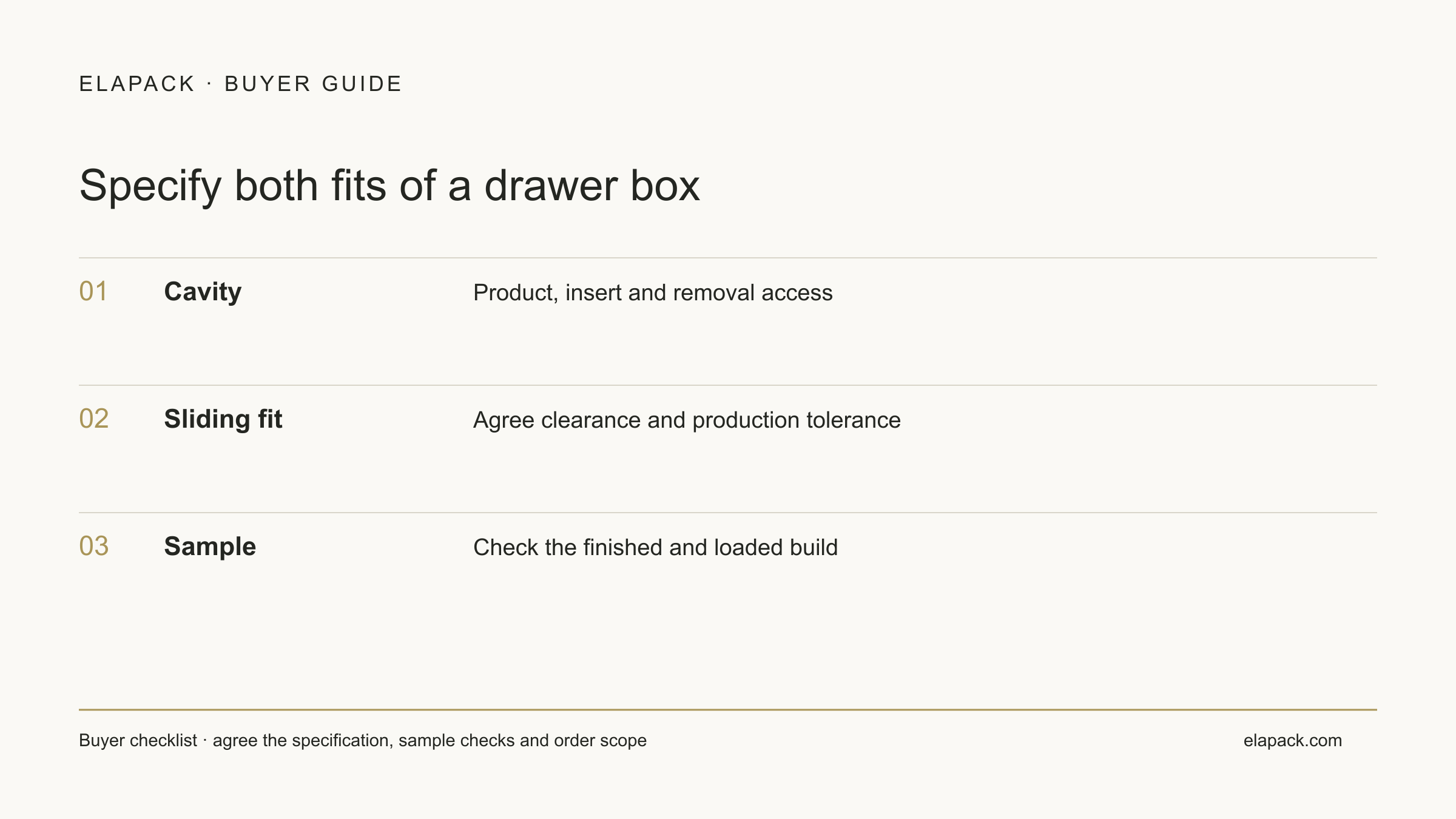
Quick answer: a drawer box combines a sleeve and sliding tray. Specify the loaded product cavity separately from the tray-to-sleeve fit. Ask for a proposed clearance and production tolerance, then approve the finished, loaded sample under the intended storage and handling conditions.
Product fit and sliding fit answer different questions
The product cavity must accommodate the item, insert and wrapping. The sliding fit concerns the outside of the finished tray and inside of the finished sleeve. A product that fits its cavity can still sit in a tray that binds or moves too freely.
Clearance is the intended separation between mating surfaces. A production tolerance is the permitted deviation from a specified dimension. They should not be averaged or substituted for each other. Ask the supplier to show the measurement points, whether a clearance is per side or total, and whether dimensions apply before or after wrapping and finishing.
Record the proposed values on the approved drawing. There is no universal millimetre allowance in this guide: suitability depends on the construction, size, finish, load and conditions. The packaging specification sheet guide provides the wider specification workflow.
Sample the finished build
Review the actual product and insert in the sample. Check that the tray opens without damaging the wrap, that the pull remains attached, and that unwanted movement is controlled. Agree repeat-opening checks and acceptance criteria with the supplier rather than treating an arbitrary cycle count as a test standard.
Paperboard fit can change with moisture conditions. State the destination and expected storage conditions, then ask whether conditioning and repeat checks are needed. Do not infer performance in humid storage from a sample reviewed only in a different environment.
Wrapping, folds, adhesive and finishes can change the finished dimensions. Recheck fit after those elements are included; a bare-board mock-up does not establish the fit of the decorated version.
Board and pull selection
Ask for a board proposal based on the product weight, dimensions and presentation requirements. A thicker board is not automatically a smoother sliding box, and board thickness alone does not establish stacking strength or transport protection. See the rigid boxes guide for the related construction questions.
Possible pull concepts include a ribbon, tab or finger notch. Confirm availability for the design, the attachment detail and clearance at the sleeve opening. A ribbon used as a drawer pull has a different function from a tie that closes a hinged box.
Ask whether the selected construction ships assembled or can be supplied in another format. Compare actual packed dimensions and assembly requirements; do not assume that all drawer boxes share one shipping arrangement.
Drawer versus magnetic closure
| Decision | Drawer format | Magnetic hinged format |
|---|---|---|
| Opening | Tray slides relative to sleeve | Hinged lid opens from the closure |
| Sample check | Sliding fit, retention and pull attachment | Alignment, retention and opening feel |
| Protection | Check the loaded pack and proposed transit outer | Check the loaded pack and proposed transit outer |
| Cost comparison | Quote the same product fit, finish, quantity and destination | Use the same comparison scope |
Neither mechanism proves that a parcel will remain closed in a drop or prevent damage. Agree the transit outer and route-appropriate testing separately. A competitor's percentage saving is not an ELAPACK quotation. Compare matched quotations rather than assuming the drawer or magnetic format is cheaper. The magnetic gift boxes guide covers the alternative closure.
What to include in an enquiry
| Field | Buyer input or supplier confirmation |
|---|---|
| Product and insert | Dimensions, weight, contact surfaces and removal requirements |
| Finished tray and sleeve | Drawing, measurement points and proposed clearance |
| Production tolerance | Agreed dimensional limits and inspection method |
| Storage and route | Destination, expected conditions and transport outer |
| Decoration | Wrap, print, finish and pull details on the same revision |
| Sample approval | Loaded fit, opening, retention and agreed checks |
| Quantity | MOQ 200 pieces; confirm artwork and colour allocation in the quote |
ELAPACK's custom sample is USD 30 plus USD 25 shipping, with a 3–5 day sample-making timeframe. Stock samples are free with USD 25 shipping and a stated delivery timeframe of 4–7 days. Confirm suitability and timing for the project. Production is typically 15–20 days after sample approval and payment receipt, subject to order confirmation.
For a complete set, the MOQ is 200 pieces for each component, with the component specification and allocation confirmed in the quotation. Free digital dieline previews support structure approval; they do not replace physical sample checks.
Contact ELAPACK with the product dimensions, quantity, finish reference and destination. Request the proposed construction and a sample-review plan before approving bulk production.