Format and dimension descriptions below are as published on supplier pages read 18 October 2026 (sources named inline) and are quoted for comparison, not as ELAPACK stock specifications. Order terms — MOQ 200 pieces, 15–20 day production, custom sample USD 30 plus USD 25 shipping, free digital dieline previews — are ELAPACK's confirmed trade terms.
Necklaces and bracelets are the two jewelry formats that punish a generic box most visibly — one tangles, the other slides. This page covers single-item boxes for necklaces and bracelets specifically. The ring side has its own page in the custom ring boxes guide, earring cards in the custom earring cards guide, and the wider box family in how to choose custom jewelry boxes. This page is the sourcing detail for the two chain-and-cuff formats those pages do not dig into.
Quick answer: choose the packed layout from the actual necklace, pendant, chain, bracelet or cuff. Review positioning, contact and removal before choosing the box. Tabs, slots and supports are options to test, not a guarantee against tangling or movement. ELAPACK MOQ is 200 pieces; confirm the selected construction and order schedule.
Key facts at a glance
| Item | Figure or input | Basis |
|---|---|---|
| Minimum order | 200 pieces; confirm design allocation | ELAPACK confirmed terms |
| Production | Typically 15–20 days after sample approval and payment receipt; confirm by order | ELAPACK confirmed terms |
| Custom sample | USD 30 plus USD 25 shipping; 3–5 day sample making | ELAPACK confirmed terms |
| Digital dieline preview | Free for structure approval | ELAPACK confirmed terms |
| External catalogue examples | Oslo small pendant 64 × 64 × 39 mm; necklace 160 × 160 × 34 mm; bracelet 219 × 55 × 23 mm | Westpack Oslo catalogue, checked 22 October 2026; not ELAPACK specifications |
| Insert task | Position the actual piece and permit removal | Project drawing and loaded sample |
The three formats that carry necklaces and bracelets
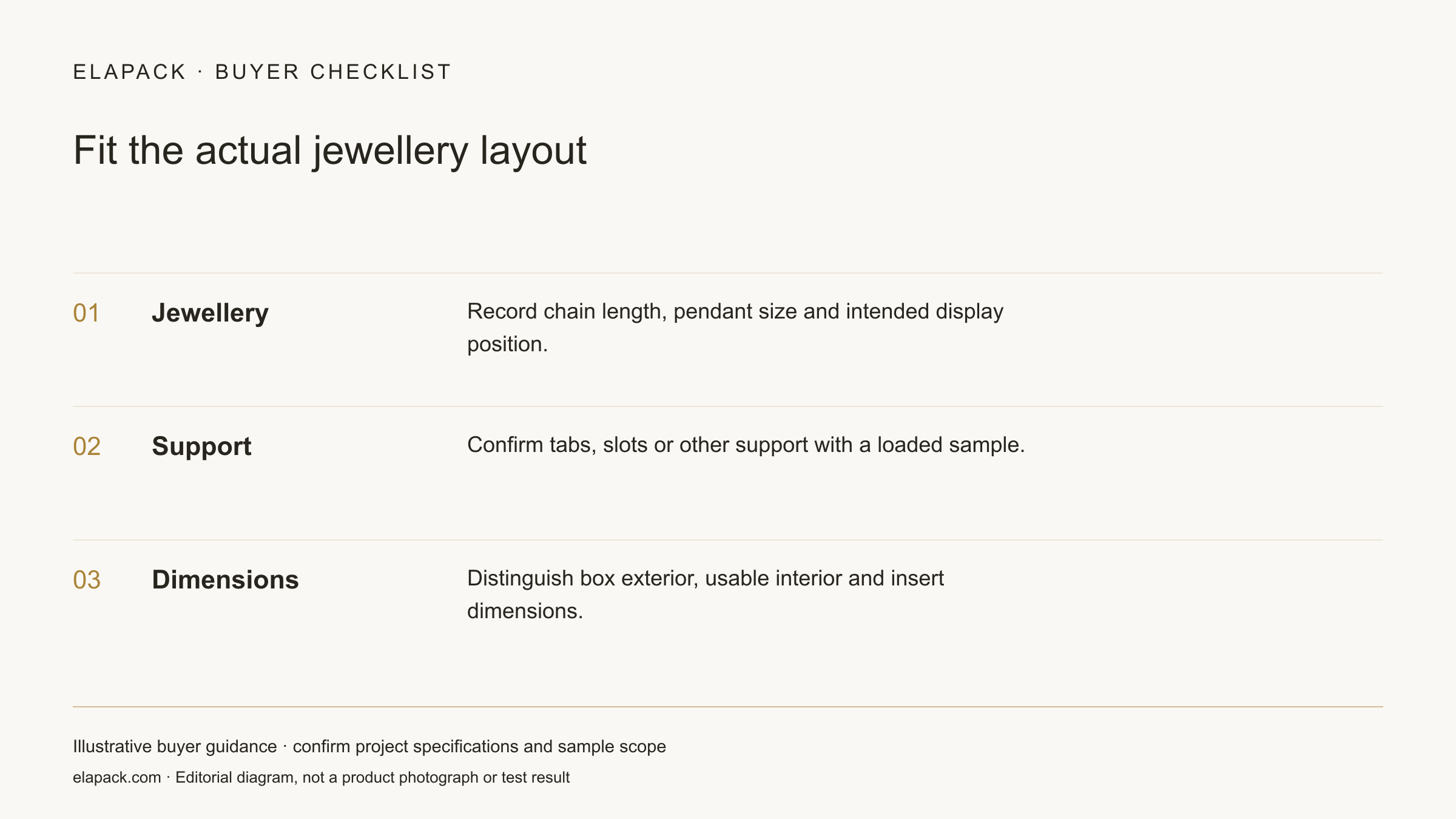
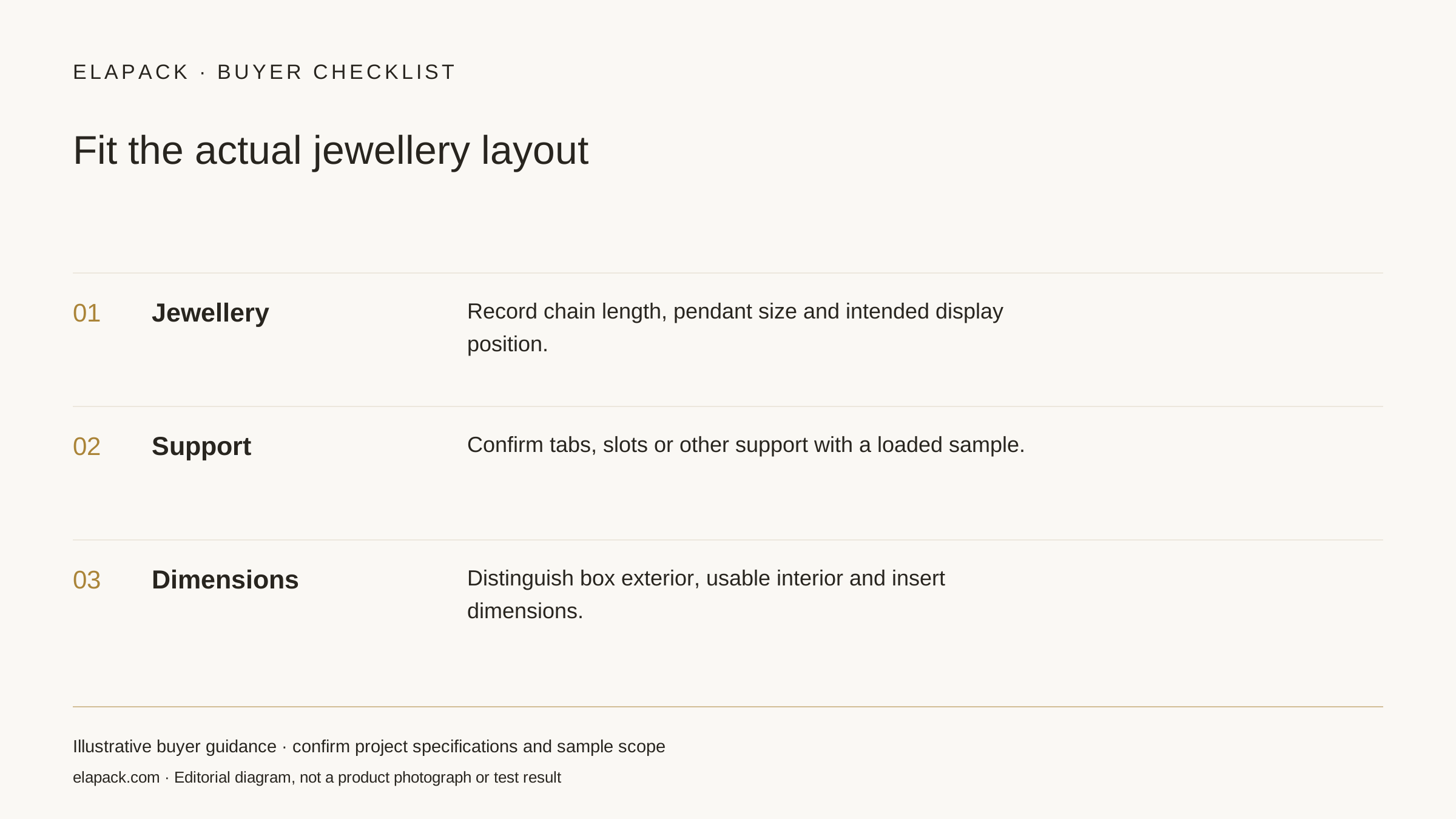
External catalogue examples show why the product reference matters. Westpack’s Oslo series currently lists small-pendant, necklace and bracelet items at 64 × 64 × 39 mm, 160 × 160 × 34 mm and 219 × 55 × 23 mm respectively. These dimensions identify those particular supplier items; they are not ELAPACK sizes, internal-cavity measurements or a rule that every piece fits that format. Choose the proposed layout from the actual jewellery and confirm usable interior dimensions with its insert.
The ordering logic is the useful part: measure the piece first, then pick the format, then specify the interior. A buyer who starts from "a nice box" and works backward to the chain usually ends up with a box that is either too tight to close over the fold or too roomy to hold the piece still.
Takeaway: choose the usable interior and support from the actual packed jewellery layout.
Chain control: why necklaces tangle and how the box stops it
Unwanted movement can allow a chain to loop or become tangled. Evaluate tabs or another restraint together with chain thickness, pendant, clasp and removal access. Westpack discusses chain-control features on its jewelry boxes page; that supplier example is not evidence that every chain requires the same attachment or will arrive untangled.
Assess restraint and external protection separately on the complete assembly. A generic box does not establish impact protection, and a necklace-labelled box does not prove retention. Review the bracelet or chain in the proposed insert with the intended handling and shipping pack.
Provide total chain length, pendant and clasp dimensions, the intended folded or laid-out arrangement, and the maximum packed height. The box interior follows the approved arrangement, not necessarily the chain laid straight. Review access and unwanted contact on the loaded sample.
Takeaway: the chain-control element is what makes it a necklace box; ask for it by name, not as "a nice interior."
Bracelet boxes: interior length, support and the bangle fit
Provide the actual bracelet, cuff or bangle profile, maximum dimensions, intended orientation, opening access and contact requirements. A chain bracelet and rigid cuff can need different supports. Confirm the usable cavity and loaded height on the sample rather than using one laid-out length measurement for every style.
Compare current supplier quotations using the same customisation scope, material, size, insert, quantity and delivery terms. A published minimum does not show whether a proposal is stock or made-to-measure. ELAPACK MOQ is 200 pieces; typical production is 15–20 days after sample approval and payment receipt, confirmed by order.
Takeaway: compare the actual product fit and quotation scope rather than classifying suppliers by MOQ alone.
Materials and finishes for presentation-grade boxes
Presentation grade comes from the pairing of surface and interior. Westpack's listings run matte-black cardboard with a black foam insert at the entry end, and black leatherette with a black velour interior at the presentation end, plus soft-touch finishes. The construction logic is the same as the insert page: the outer surface carries the brand, the interior covering carries the scratch control, and the two should be named in the same quotation.
ELAPACK's necklace-and-bracelet path runs on the same materials the custom jewelry boxes collection documents — velvet interiors over foam, or a faux-leather wrap — with the insert cut to the piece. A magnetic closure is a design option; review retention, alignment and opening access on the loaded sample rather than assuming one-handed use.
Takeaway: specify surface and interior as a pair; magnetic closure is an add-on, not a default.
Ordering: dimensions, inserts and the sample route
The enquiry that avoids a re-draw lists: for a necklace, the total lay-flat chain length and the pendant diameter or drop; for a bracelet, the laid-out length and the rise above the insert; then the box format, the interior (a longer insert or a cushion), magnetic closure or not, and the quantity. ELAPACK's minimum is 200 pieces.
Confirm the product dimensions and packed arrangement before approving the proposed drawing. Free digital dieline previews support structure review. Custom samples cost USD 30 plus USD 25 shipping, with 3–5 day sample making; typical production is 15–20 days after sample approval and payment receipt, confirmed by order.
The sample is where the two failure modes are tested: does the necklace fold once and stay flat with the clasp reachable, and does the bracelet sit along its insert without sliding to the end. Send the necklace and bracelet dimensions and quantities and the format recommendation comes back with the quote.