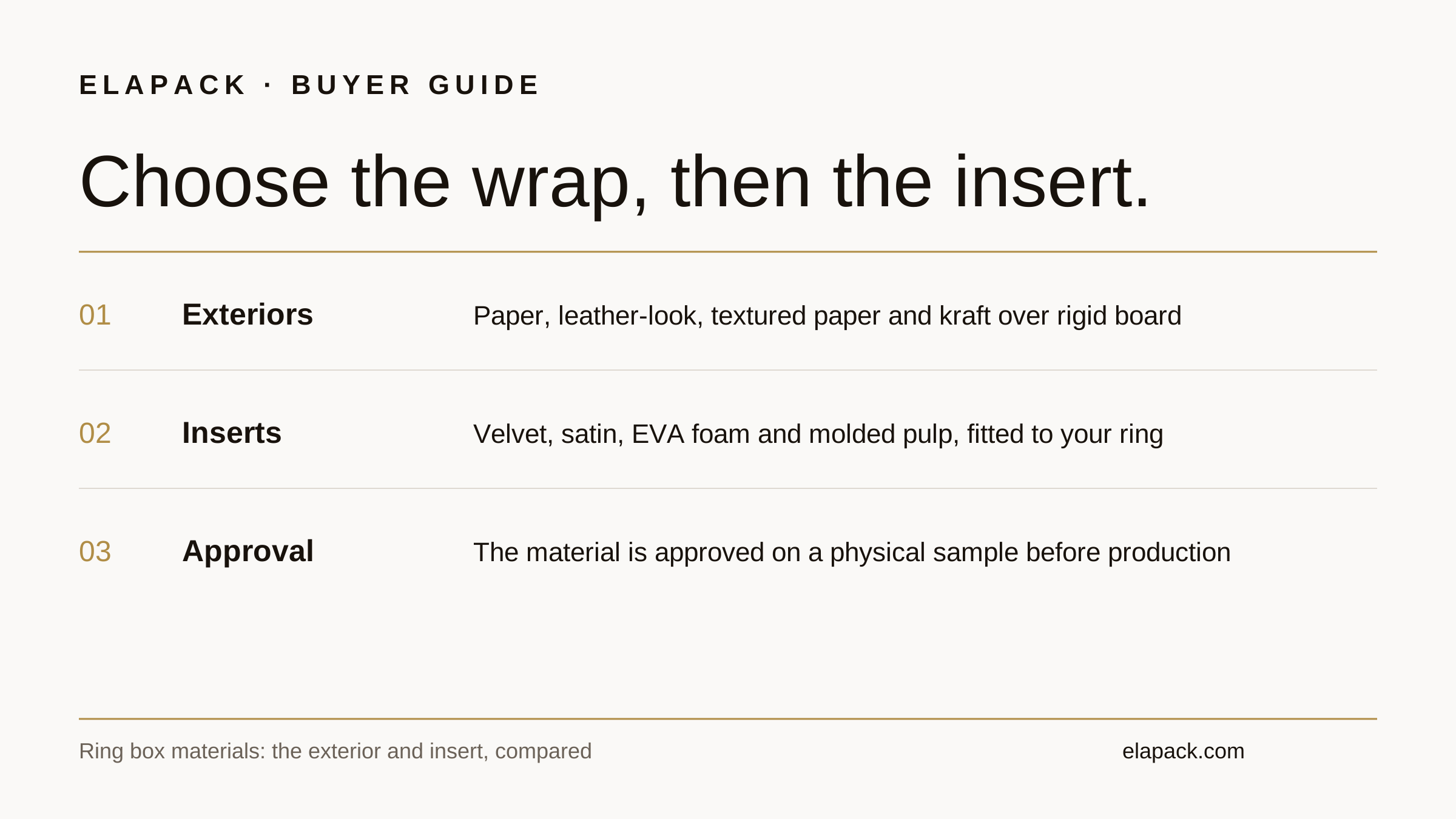
A custom ring box is a rigid board core wrapped in a material you choose — and the insert is chosen separately. This guide compares the exterior and insert options ELAPACK offers, what each one does to print, finishes and presentation, and how the final material is approved on a sample.
Quick answer: Choose the exterior by the artwork and hand feel the box must carry — printed paper wrap for full artwork, leather-look wrap for a uniform tactile surface, textured paper when the surface itself is the design, kraft for a natural unprinted look. Choose the insert by how the ring is presented and held — velvet or satin for a soft presentation surface, EVA foam when the slot must be cut precisely to the band, molded pulp for a matte paper-based insert. Every combination is confirmed in the quotation and approved on a physical sample before production.
Key takeaways
- A ring box has three material decisions, not one: the exterior wrap, the interior surface and the insert. Each is specified separately in the quotation.
- Printed artwork needs paper wrap; leather-look and textured wraps carry logos mainly through foil or embossing, and kraft prints muted because the ink sits on a brown base.
- The insert is a fit decision as much as a look: EVA foam is cut to the ring's dimensions, while velvet and satin present the ring on a soft slotted surface. Fit itself is checked with your actual ring — see the sizing guide linked below.
- Finishes are not interchangeable across materials: spot UV belongs on printed paper wrap, embossing needs a wrap with enough body, and foil reads differently on smooth and textured surfaces.
- Materials are approved on a physical custom sample (USD 30 plus USD 25 shipping, made in 3–5 days). The material named in the quotation and confirmed on that sample is the material production follows.
What materials can a custom ring box be made from?
Every custom ring box starts from the same structure: a rigid board core that gives the box its shape and strength, wrapped outside and lined inside. The board itself is not the visible decision — its thickness and construction are confirmed in the quotation — so buyers are really choosing three things.
The exterior wrap is what the customer sees and touches:
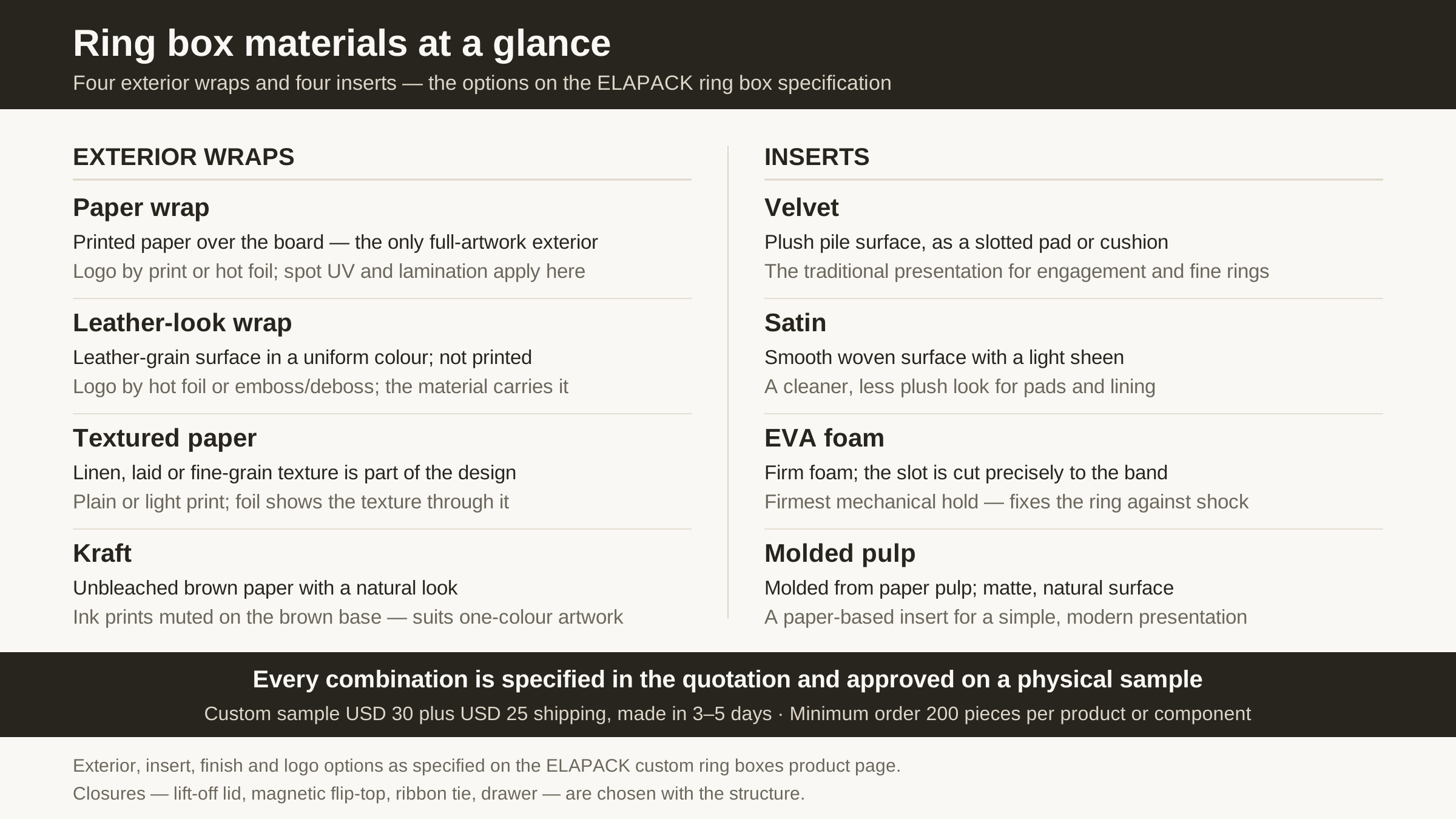
- Paper wrap — a printed paper over the board. This is the only exterior that carries full artwork: photographs, gradients, patterns and printed brand colours, in CMYK or spot colour.
- Leather-look wrap — a leather-grain surface in a uniform colour. Nothing is printed on it in the usual case; the branding is applied by foil or embossing, and the material itself supplies the premium feel.
- Textured paper — paper whose surface texture (linen, laid, fine grain) is part of the design. Colours stay plain or lightly printed, and the texture does the visual work.
- Kraft — unbleached brown paper for a natural look. Ink prints muted on the brown base, so kraft suits simple one-colour artwork rather than colour-critical designs.
The insert is what holds the ring: EVA foam, velvet, satin or molded pulp, fitted to your product dimensions. Section three compares them.
The closure — lift-off lid, magnetic flip-top, ribbon tie or drawer — is chosen with the structure, and it interacts with the material: a ribbon tie, for example, is usually paired with a plain wrap whose surface the ribbon decorates.
Which exterior suits an engagement ring box?
Start from what the box has to do at the moment it is opened, not from a material catalogue.
For a single engagement ring, the box is opened once, close up, and photographed. A leather-look or textured wrap in a deep, plain colour with a foil logo keeps the attention on the ring; a velvet insert in a contrasting or matching tone is the classic presentation. Nothing about the exterior needs to carry information — there is no artwork to print — so the tactile materials earn their place.
For a retail ring line, the box repeats across many SKUs and often sits next to other packaging. Paper wrap becomes the practical choice: the range's colours and patterns print consistently from box to box, and printed interiors or message cards can be added in the same system.
For a ring box inside a set, the wrap is chosen against the other components — bag, pouch, card — so the set reads as one design. Colour matching is then done against the approved sample (printed colour is accepted within ΔE ≤ 2.0 of the reference), and the same wrap family is usually carried across the set's boxes.
If the design brief includes photographic or patterned artwork, the decision is already made: only the paper wrap carries it. If the brief is a plain colour and a metallic logo, all four exteriors remain open and the choice is about hand feel.
Velvet, satin, EVA or molded pulp — which insert should you choose?
The insert holds the ring in place and forms the surface it is presented on. The four options differ in how they hold and how they read:
- Velvet — a plush pile surface, usually as a slotted pad or cushion. The ring sits in the slot and the pile frames it. This is the traditional presentation for engagement and fine jewelry rings.
- Satin — a smooth woven surface with a light sheen, used for pads and lining where a cleaner, less plush look is wanted.
- EVA foam — a firm foam that is cut precisely, so the slot can be shaped to the band width and setting height of a specific ring. Choose it when the fit must be mechanical and exact rather than soft — for heavier settings, or rings that travel inside the box. A fitted insert is also the protection option: it is what fixes the ring against movement and shock in transit.
- Molded pulp — an insert molded from paper pulp, with a matte, natural surface. It suits brands whose packaging is paper-based throughout, and it takes a simple, modern presentation rather than a plush one.
| Insert | Surface | Suits |
|---|---|---|
| Velvet | A plush pile surface, usually as a slotted pad or cushion; the ring sits in the slot and the pile frames it | The traditional presentation for engagement and fine jewelry rings |
| Satin | A smooth woven surface with a light sheen, used for pads and lining | A cleaner, less plush look |
| EVA foam | Firm foam, cut precisely so the slot can be shaped to the band width and setting height of a specific ring | When the fit must be mechanical and exact rather than soft — heavier settings, or rings that travel inside the box; also the protection option, fixing the ring against movement and shock in transit |
| Molded pulp | Molded from paper pulp, with a matte, natural surface | Brands whose packaging is paper-based throughout; a simple, modern presentation rather than a plush one |
Material choice and dimensions are one decision, not two: the slot that holds the ring is sized from the band width and setting height you supply, and retention and removal are checked with your actual ring in the approved sample. Our ring box sizing guide covers that matched specification in full — read the two guides together before sending an enquiry.
How do finishes change each material?
A finish that works on one wrap can fail on another, because finishes interact with the surface:
- Foil stamping reads crisp and metallic on smooth paper wrap and on leather-look wrap — it is the standard logo method for both. On textured paper the texture shows through the foil, which can be a deliberate effect but is not the clean metallic most buyers picture; check it on the sample.
- Embossing and debossing need a wrap with enough body to hold the impression. A blind debossed logo on leather-look wrap is a recognised premium treatment precisely because it uses no ink at all — the material carries the mark.
- Spot UV is a print finish: it is applied over printed areas, so it belongs to paper wrap. It cannot be specified on an unprinted leather-look or kraft surface.
- Matte or gloss lamination applies to paper wraps and changes both colour and feel — matte softens contrast, gloss raises saturation — which is why printed colour is approved on the finished, laminated construction rather than on a flat proof.
The logo methods confirmed for ring boxes are hot foil, emboss/deboss, and screen or digital print, with Pantone-matched colours on request for printed wraps. For the full comparison of finishes across packaging, see our surface finishes guide.
How do you approve the material before production?
A material name in a quotation is a proposal. The approved sample is the reference production follows, and for materials this matters more than for dimensions: a photograph cannot carry the pile of a velvet, the grain of a leather-look wrap or the depth of a deboss. Those are judged in hand.
Order the custom sample in the exact combination you intend to run — wrap, insert, closure and logo method together. On the sample, check the wrap's colour against your reference, the texture and hand feel, the logo in its chosen method, and the ring's retention and removal in the insert. Finished-sample photos or video can also be sent before dispatch on request, but for material approval they support the physical check rather than replace it.
| Stage | Terms |
|---|---|
| Custom sample | USD 30 plus USD 25 shipping, and 3–5 days to make; any first-order fee credit depends on the product and order and must be confirmed in the quotation |
| Sample confirmation | Confirm the sample by email; bulk production starts only after that confirmation and payment |
| Bulk production | 15–20 days for 200 to 20,000 pieces; 30–35 days for 20,000 to 50,000 pieces |
The minimum order is 200 pieces per product, or per component when the ring box is part of a set; how sizes, colours and artwork are allocated across the run is confirmed in the quotation. How a ring box is specified as part of a wider jewelry packaging set is covered in our custom jewelry packaging guide. The ring box product page sets out the full specification to send with an enquiry.
Questions buyers ask
Can a ring box be made in real leather or wood?
The standard exterior options are paper wrap, leather-look wrap, textured paper and kraft over a rigid board core. If a project needs a material outside this list, name it in the enquiry — it will be confirmed or declined in the quotation rather than assumed, and it is only ever scheduled once a physical sample of that material has been approved.
Which insert holds a ring most securely?
By mechanism rather than by test data: an EVA insert cut to the band gives the firmest mechanical hold, while velvet and satin hold the ring by its slot in a soft surface. Which is secure enough depends on the ring and how the box travels — the deciding check is retention and removal with your actual ring, done on the approved sample before production.
Can the box, lining and insert be different colours?
Yes. The exterior wrap, the interior surface and the insert are specified separately in the quotation, so a navy wrap with an ivory insert is a normal brief. Approve the combination on the sample, because colours read differently against each other than they do alone.
Does the material change the price of a ring box?
Material and finish are real cost drivers, and they are priced in the quotation for the specified combination — there is no published price per material. To compare quotations from different suppliers fairly, hold the specification constant: same wrap, same insert, same logo method. A cheaper quote on a different material is not a cheaper quote for the same box.
Sources
- ELAPACK — Custom Ring & Engagement Ring Boxes — the exterior, insert, closure, finish and logo options compared in this guide, as specified on the product page.
- ELAPACK confirmed terms — MOQ 200 pieces per product or component; custom sample USD 30 plus USD 25 shipping in 3–5 days, with any first-order fee credit subject to the product and order quotation; colour accepted within ΔE ≤ 2.0 of the approved sample; production 15–20 days for 200–20,000 pieces and 30–35 days for 20,000–50,000 pieces after sample approval by email and payment.