
Product facts and ordering terms below are this factory's published trade terms. Supplier terms are quoted as published on supplier pages and public community threads, read 15 October 2026, for comparison only. Community sentiment is summarised from public Reddit discussions, read 15 October 2026.
Small fragrance brands keep asking the same question in public, in the same words: where do you actually buy perfume packaging? The threads recur across r/DIYfragrance and r/Packaging — bottles, boxes, minimums, shipping — and the answers that come back are fragments: try Alibaba, shipping costs more than the boxes, one bundler's name. What the community does not have is the map: how many kinds of supplier there are, which one sells which half of a fragrance programme, and what each one is good and bad at. This page is that map, from a factory that sits on one rung of it.
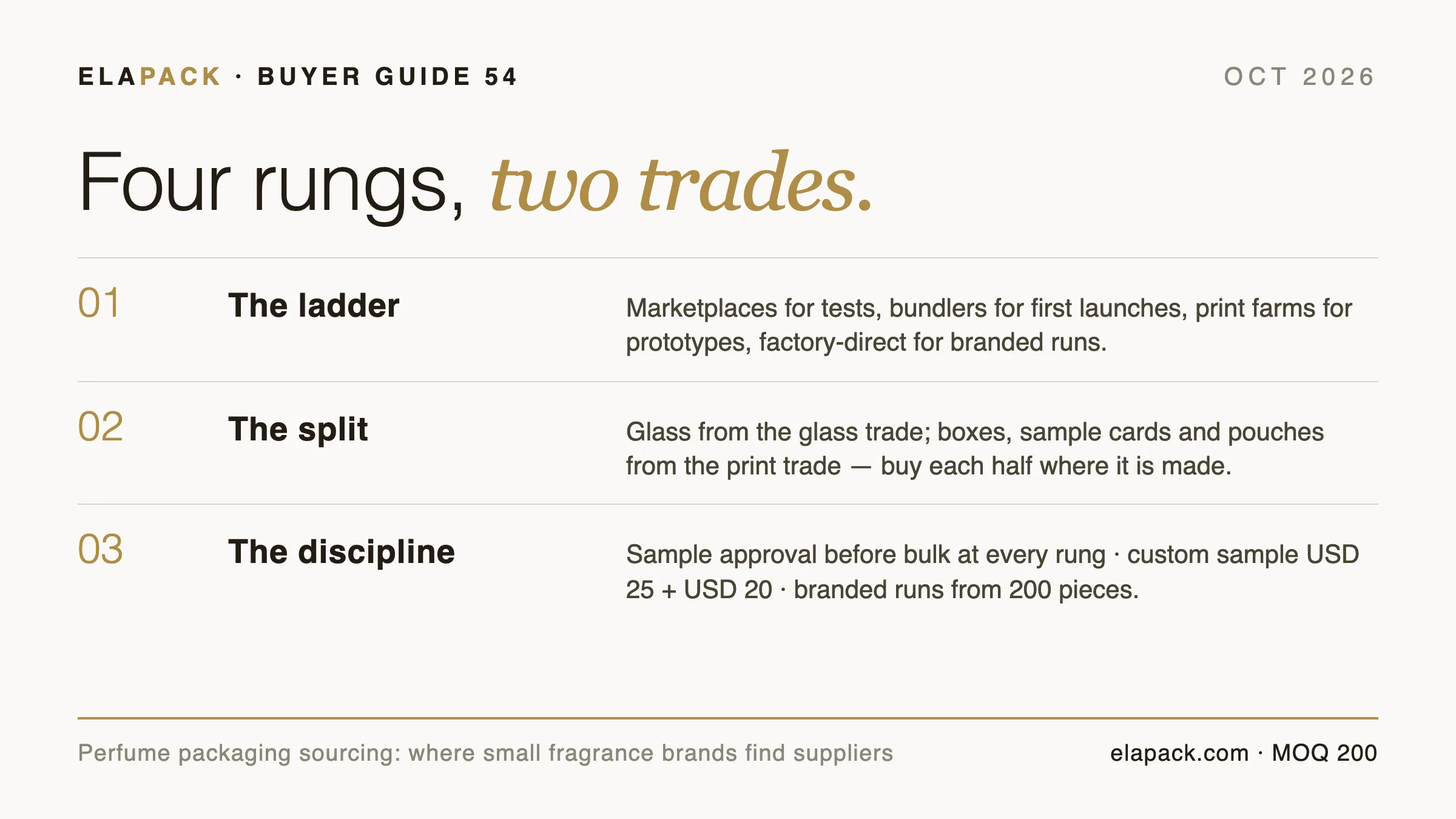
Quick answer: a fragrance programme splits into two purchases — glass (bottles, pumps, sprayers) from the glass trade, and everything printed or textile (boxes, sample cards, pouches) from the packaging trade — and the supplier ladder has four rungs: marketplaces for tests, bundlers for first-launch convenience, print farms for no-minimum prototypes, and factory-direct for branded runs from around 200 pieces. Buy each half where it is made, and hold both to sample approval before the first bulk run.
What the community actually asks
The recurring threads, read 15 October 2026: bottles-and-packaging sourced together on Alibaba at "very good prices, even for orders of 100 bottles or boxes, but the shipping cost is often higher than" the goods; a founder asking about custom bottles with atomizers and branded packaging for a small DIY line; a packaging supplier describing how small brands approach bottle manufacturers; a box-buying thread reporting "surprisingly good luck with Alibaba" — manufacturers with low minimums exist, at higher unit costs.
Three needs sit under all of them. First, small quantities without punitive economics. Second, one place that sells the whole programme, because a founder sourcing bottles, boxes and labels separately is doing three jobs. Third, some way to trust a supplier they cannot visit. Every rung of the ladder below answers a different two of those three.
The four rungs of the supplier ladder
| Rung | What it is | Strength | Cost of that strength |
|---|---|---|---|
| Marketplace (Alibaba, marketplaces) | many factories, listed | low minimums, price discovery | shipping can outrun goods; vetting is on you |
| Bundler (e.g. Packamor, as published) | bottles, boxes, labels from one catalogue | one PO for the whole launch | catalogue choices; less specification |
| Print farm (no-minimum customisers) | print-on-demand boxes | prototypes at entry prices | unit economics do not scale |
| Factory-direct (this factory's rung) | your dieline, your materials | specification at branded-run volumes | minimums around 200 pieces |
The bundler rung deserves its popularity: Packamor publishes orders from 70 units to 10,000+ with bottles, boxes, labels and decoration in one place (as published, read 15 October 2026). What it sells is convenience, priced in catalogue sizes and stock components. The print-farm rung is the mirror image — your artwork, their stock, no minimum, and a unit price that never improves. Factory-direct is where a brand lands once one SKU has proven it can sell: specification, a dieline drawn to your bottle, materials chosen rather than accepted.
The ladder is climbed in one direction — test on the low rungs, but move the branded run up as soon as a SKU repeats.
The split that saves the most grief: glass and print
The single most useful boundary in fragrance sourcing is also the least documented: bottles, pumps, sprayers and collars are the glass trade's product; boxes, sample cards and pouches are the print-and-textile trade's. A packaging factory that implies it makes your bottles is reselling someone else's line with a margin on it. A bundler sells the combination honestly — that is its business — but a brand that wants its own bottle spec buys glass where glass is made.
The community's Alibaba experience lands exactly on this line. The marketplace lists both trades side by side, which is why a 100-bottle order is possible and why the shipping line hurts: glass is dense, factories are far, and a split programme ships twice. The workable sequence for a small brand is the one the wholesale perfume boxes guide details — glass first, box drawn to the confirmed bottle, inserts cut to the bottle profile — and the trial side of the programme runs on sample cards at a fraction of the glass cost.
Sample-first, at every rung
The discipline that transfers across the whole ladder is sample approval before bulk, and it costs less than most founders assume. At this factory: a stock sample ships free in 2–3 days plus USD 20 courier; a custom sample is USD 25 plus USD 20 shipping, built 3–5 days from confirmed artwork. What a sample should prove — board, print, fit, colour — is the packaging samples guide's subject, and the questions that separate a factory from a listing are in the manufacturer vetting checklist. The community threads skip this step out of hurry; the re-order threads that follow usually trace back to it.
What a first branded run looks like
| Line item | Terms |
|---|---|
| Boxes, cards, pouches | from this factory, MOQ 200 pieces per design |
| Production | 15–20 working days (200–20,000), from sample approval and deposit |
| Samples | stock free + USD 20 shipping (2–3 days); custom USD 25 + USD 20 (3–5 days) |
| Glass | from the glass trade — specified separately, approved on its own samples |
| Payment and freight | T/T or PayPal; air or sea from Shanghai or Shenzhen |
A first branded run pairs one bottle with one box structure and one sample card — the programme map is the custom perfume packaging guide's subject — and the calendar arithmetic (samples approved early, production 15–20 days, freight behind both) is what turns a launch date into an achievable one.
Bottom line
Climb the ladder deliberately: marketplaces and bundlers for proof of concept, factory-direct for the branded run — and split glass from print from the first order, because the two trades are different and pretending otherwise is how small brands pay twice. Start the quote with bottle dimensions and target volumes; the dieline comes back with it.