Box styles, stock lists, glue-tube dimensions, film gauges and MOQ figures from named suppliers and publishers below are industry references as published by those sources and cited inline; they are not ELAPACK specifications. ELAPACK’s confirmed trade terms — MOQ 200 pieces, custom sample USD 30 plus USD 25 shipping with 3–5 day sample making, production typically 15–20 days after sample approval and payment receipt, free digital dieline previews — apply as stated.
A press-on nail brand lives or dies on presentation, and the box is where the customer meets the product. But a nail box is not specified like a gift box: it is specified outward from the tray it holds — and, as this guide works through, upward from the adhesive it ships with. The wider programme decisions (channel structures, quote preparation) are collected in our press-on nail packaging guide; this page stays on the box itself — sizes, depths, protection — and ends at the order terms for custom press-on nail boxes.
Quick answer: specify the tray first — nail count, tray footprint and thickness, accessory list — then let the adhesive set the depth: tab-only sets fit the slim published formats around 15 mm high; a kit carrying a glue tube moves to the ~25 mm kit tier. Then the format (single-set sleeve, multi-size kit, retail display pack or mailer), the insert and the print. ELAPACK’s minimum is 200 pieces; custom samples take 3–5 days and production typically 15–20 days after sample approval and payment receipt.
Start from the nail tray, not the box
Press-on sets are graded size systems, not bags of identical nails. Sellers in the press-on communities describe sizing kits built from clear tips in as many varieties as they can source — up to sixteen sizes in the threads we read on r/PressonNail_Addict. And the “24 nails” on the front of a kit is a retail format, not a count of one size: Oxo Packaging’s FAQ for its nail boxes explains that brands use odd numbers as a marketing strategy, with a 24-piece set mixing sizes and no more than ten nails of any single size.
That reality sets the box. The tray’s footprint and thickness — plus the glue, the prep pad, the mini file, the alcohol wipe — determine the internal clearance the box must provide. Quote three fields, not one: the tray dimensions, the nail count and size range per set, and the accessory list. A box quoted from an outside dimension alone is a box that will be re-quoted.
This is also why stock size lists only take you so far. The Product Boxes publishes twenty-three stock sizes and 7Packaging publishes a sizes-by-use table (its 2.5 × 1.5 × 0.75 in. format holds a single 10–24 nail set with mini glue tabs; 3 × 2 × 1 in. adds an insert card, prep pad, mini file or adhesive tube for direct-to-consumer sets). Those tables are useful anchors — but they describe that supplier’s trays, not yours.
The depth threshold: the adhesive sets the box profile
The re-spec to watch for in press-on packaging is height. The accessory list — specifically the adhesive — decides the internal depth, and the published size tables encode exactly this step.
Ono Custom Boxes’ dimension guide puts slim press-on formats at 80 × 50 × 15 mm — the profile of a set carrying flat adhesive tabs, a prep pad and a flat stick. 7Packaging’s table moves from its 2.5 × 1.5 × 0.75 in. single-set row to the 3 × 2 × 1 in. row — 76 × 51 × 25 mm — precisely when “an insert card, prep pad, mini file or adhesive tube” joins the set. Two published tiers, one cause: what the adhesive is.
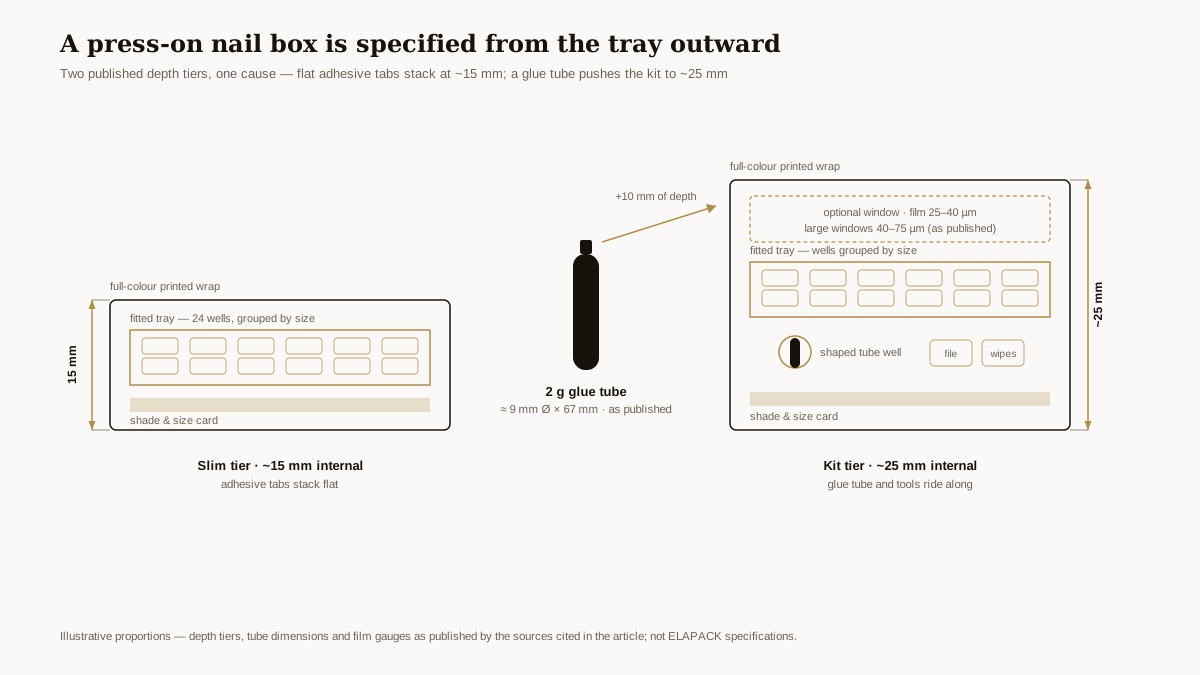
The reason a tube costs roughly ten millimetres is geometry. A standard 2 g cyanoacrylate tube is a cylinder — the published product specification for a professional 2 g tube runs about 9 mm across and 67 mm long. Nail tips and adhesive tabs stack flat; a cylinder stands proud of the tray. Specified to the nail-tip curve alone, the box comes back with a lid that bulges or a drawer that jams — a structure failure caused by an accessory nobody put on the enquiry.
So quote the adhesive explicitly. Tabs-only sets can run the slim, letterbox-friendly profile at the published ~15 mm tier; a tube-plus-tools kit needs the ~25 mm tier and a shaped well for the cylinder. The well is a tray feature, not an afterthought: published kit formats give the tube its own slot alongside the file and wipes, and the depth budget follows it.
Four formats and what each is for
The format follows where the set is sold, and custom nail boxes across the market sort into four of them.
Single-set sleeve. One tray, one shade card, a slim sleeve or tuck-end around it. The workhorse of direct-to-consumer sets — the smallest sensible parcel, the cheapest freight per unit, and the format community sellers most often pack inside a shipping mailer.
Multi-size kit. Multiple trays or a tiered tray, glue, file, wipes — the 7Packaging table places its 5 × 3 × 1 in. format here, for sets carrying multiple sizes and tools with a premium feel. Rigid two-piece and drawer structures belong in this tier — and a drawer carrying a glue tube lives or dies by the depth threshold above; ELAPACK builds single-set sleeves, multi-size kits and wholesale display packs around your trays.
Retail display pack. Window fronts, hang tabs and Euro slots, barcode panels — 7Packaging lists the full retail kit of features. This format is judged from three feet away on a peg or shelf, which makes print quality and the insert layout retail decisions, not cosmetic ones.
Mailer-style box. The e-commerce outer. The seller groups we read describe the practical arithmetic: a 6 × 4 in. mailer fits roughly four boxed orders, and many sellers ship a display box inside the mailer rather than making one box do both jobs. Which raises the question a later section answers: one dual-duty structure, or two formats?
The insert does the protection work
Press-on nails are finished surfaces in transit — the failure modes are rattling, scuffs and micro-scratches, exactly the risks 7Packaging names for its inserts. The transit problem is documented, not hypothetical: shipping guides for press-on sellers treat “arrives pristine” as the packaging brief, and the practitioner blog Nail Thoughts describes hand-securing each nail with museum putty — then records the follow-up problem readers reported: putty residue that turns gummy and is hard to remove. The community fixes are improvised retention; a fitted structure does the same job without the residue.
The insert menu, as published across suppliers, runs: printed card inserts and SBS cards, tray-style inserts, foam inserts and molded cavities, each cut to hold nail sets and accessories. The card-versus-foam choice follows the depth arithmetic above: card holds the tray and carries the printed size map, and moves with paper recycling streams; foam cushions loose accessories and fills the depth a glue-tube kit carries; molded cavities suit premium kits where every component has an assigned seat. Most kits combine — a card or tray for the nails, a formed well for the tools. The full five-decision framework for the whole nail programme is in the packaging guide linked above; for the box at hand, ELAPACK’s build is the fitted tray insert — cut to your trays and accessories to hold everything in place in transit or on the shelf; judge the fit on the sample before you approve it.
Showing the shade and size system on the box
A press-on kit is a shade and size system, and the packaging is where the system becomes legible. Window fronts let the tray itself show the gradient; printed shade numbering and size maps on the insert card let the customer match a nail to a size before opening; barcode or QR panels go where retail requires them. How logo techniques and OEM-versus-ODM production interact with MOQs is covered in the custom packaging MOQ, OEM and ODM guide.
Where a window is used, the film is a specification field, not a cosmetic one. Published film-selection guides walk the choice — PET, PVC, BOPP and acetate differ in clarity, food-contact suitability and cost — with standard window gauges at 25–40 µm and large or lid windows stepping up to 40–75 µm (PackOasis; Netpak). And equipment-maker guidance notes that standard PET film itself is relatively prone to scratching (Tamarack) — a real consideration for a windowed box that rides inside a shipping mailer. Name the film and gauge in the enquiry the way you name the board.
The print method carries the shade system. Full-colour CMYK on the wrap reproduces the shade range; foil and emboss carry the brand layer. This is the one place where print quality is functional rather than decorative: a shade card that prints a half-tone off sells the wrong colour to every customer who orders a refill.
One SKU for retail and e-commerce, or two?
Most press-on brands sell through both a storefront and a warehouse pick-pack line, and the box programme has to answer for both. Two structures do it.
The first is a dual-duty structure: one box engineered to survive parcel handling and to present on a shelf — window optional, wrap-printed, rigid enough to arrive flat-faced. ELAPACK’s nail boxes are built for exactly this dual use: structures that work on a retail shelf and in an e-commerce mailer alike.
The second is the two-layer system the seller communities describe: a presentation box for the set, a plain mailer for the parcel. It costs more per order and protects the presentation box better; it also lets the retail SKU stay peg-ready without mailer compromises like tear strips or address panels.
The honest deciding factors are distribution mix and unit arithmetic: if retail is a minority of volume, two formats at 200 pieces each may cost more than one dual-duty run at higher quantity; if the presentation box is the unboxing moment on social, the two-layer system protects the asset that drives reorders.
Quantities, sampling and honest lead times
Two order routes exist in this market, and they trade different things — the market-wide comparison of MOQs, sample costs and production times is in our custom packaging MOQ and lead-times guide.
Stock-and-reseller routes publish low minimums and fast turns: The Product Boxes and Oxo Packaging both list MOQ 100 with 4–6 and 4–8 business-day rush turnarounds as published — US-fulfilled stock sizes, with fitting limited to the size lists on their pages. What that route cannot do is match a custom tray exactly, print a wrap to your shade system, or hold structure and brand steady across restocks.
The factory route is ELAPACK’s: MOQ 200 pieces, a custom sample at USD 30 plus USD 25 shipping in 3–5 days, free digital dieline previews, and production typically 15–20 days after sample approval and payment receipt. The sample settles fit and print before the run; the run holds the specification. What a custom sample should prove, what it costs and how long it takes across suppliers is covered in the custom packaging samples guide.
Neither route is universally right. A launch testing two shades at 200 sets total is a stock question; a brand with a fixed tray, a shade system to reproduce and retail listings to supply is a factory question. Send the tray dimensions, set count and launch dates, and the fit between the two comes back with the quote.
Questions buyers ask about press-on nail boxes
What size box fits a 24-nail press-on set? Anchors from published size tables: around 2.5 × 1.5 × 0.75 in. for a single 10–24 nail set with glue tabs, up to 3 × 2 × 1 in. once an insert card, prep pad, file or adhesive tube rides along (7Packaging’s table). Community sellers report 2–3 in. jewelry-style boxes holding 24-piece sets. The real answer is your tray’s footprint plus accessories — quote from the tray, not the box.
How deep does a press-on nail box need to be? Follow the adhesive. Tab-only sets fit the slim published tier (Ono Custom Boxes’ guide: 80 × 50 × 15 mm); kits carrying a glue tube move to the ~25 mm tier (7Packaging’s 3 × 2 × 1 in. row) — because a 2 g tube is a cylinder, published at roughly 9 mm across and 67 mm long, and it stands proud of a flat tray.
How many nail sizes come in a set? Community sizing kits run up to sixteen sizes; published set formats run 10 nails (simple), 24 (standard, mixed sizes — no more than ten of one size, per Oxo Packaging’s FAQ), 30–36 (multi-size kits).
Card or foam insert? Card for the tray and size map, foam for loose accessories and the depth a glue-tube kit carries, molded cavities for premium kits — most kits combine two. The wider decision framework is in our press-on nail packaging guide. For materials and trade-offs across categories, the packaging inserts guide is the deeper reference.
Can one box work on a retail shelf and in a mailer? Dual-duty structures exist and are built for both; the alternative is a presentation box inside a plain mailer. Distribution mix and per-unit cost decide.
What MOQ and lead time should I plan for? ELAPACK: 200 pieces, 3–5 day custom sample, production typically 15–20 days after sample approval and payment receipt. Stock-reseller routes publish MOQ 100 and 4–8 day rush turns — with stock-size fits only.
Free digital dieline preview for your tray. Send the tray dimensions, the accessory list (glue tube or tabs, file, wipes) and the set count, and the preview draws the tray layout, the accessory wells and the box profile to what your set actually carries — free, as part of the quote. A custom sample follows at USD 30 plus USD 25 shipping in 3–5 days, and production typically runs 15–20 days after sample approval and payment receipt. Send the tray dimensions · custom press-on nail boxes.