
Search-volume figures come from a Semrush US database export dated 7 October 2026 (cleaned keyword set). Supplier terms other than ELAPACK's are quoted as published by those suppliers, for comparison only. Terms marked as ELAPACK figures are confirmed 2026 trade terms. Soap packaging at ELAPACK is quoted as part of custom box programmes — boxes, sleeves and bands use the existing paper-board capabilities, with no separate soap price list.
This guide is for handmade-soap makers scaling past market stalls and for personal-care brands adding a bar line. Soap packaging is a rare cluster: about 5,600 US searches a month across the family, difficulty scores of 7–23, and every ranking page a print-shop product listing — nobody has written the buyer's guide. This page is that guide: formats, sizing, printing and ordering terms.
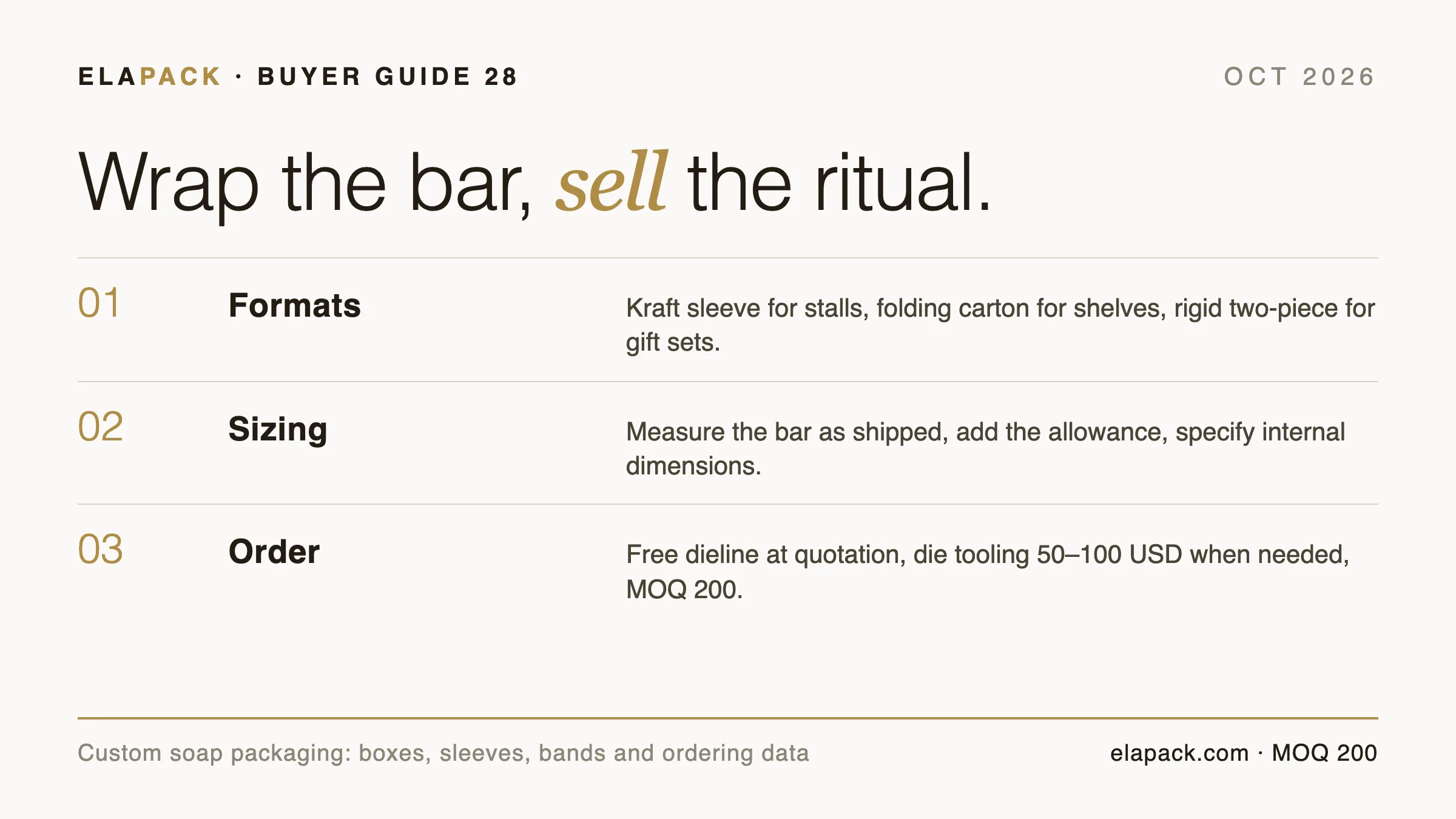
Quick answer: match the format to the retail moment. A kraft sleeve or band for market stalls and online singles; a folding carton for retail shelves; a rigid two-piece box for gift sets. Size from the bar, not from a catalogue — and hold every supplier to a written sample before the first production run. At ELAPACK the entry point is the 200-piece minimum with 15–20 day production.
Key facts at a glance
| Item | Data |
|---|---|
| Cluster head term | soap boxes — 1,600 US searches/month (Semrush, 7 Oct 2026) |
| Difficulty range | KD 7–23 across the family — one of the softest clusters in packaging |
| Handmade-buyer words | best packaging for homemade soap (260/month), how to package homemade soap (110/month) |
| Formats covered | rigid two-piece box, folding carton, kraft sleeve, wrapper paper, band |
| ELAPACK minimum order | 200 pieces, custom sizes included |
| Production time | 15–20 days at 200–20,000 pieces |
| Samples | stock sample free (USD 20 shipping); custom sample USD 25 + USD 20, 3–5 days |
What the search data says

Two buyer groups share this cluster: handmade makers (best packaging for homemade soap, how to package homemade soap) and brand buyers (custom soap boxes wholesale, soap packaging boxes). The difficulty scores — KD 8 to 14 on most specification words — are unusually soft for packaging, which means a well-structured guide page can realistically rank; the same softness is why every print shop lists a product page here.
The five formats, honestly compared
| Format | Unit cost | Best for | Weakness |
|---|---|---|---|
| Kraft sleeve / band | lowest | market stalls, online singles, naked-or-kraft-wrapped bars | limited structure; branding area is a strip |
| Wrapper paper | low | artisanal, deli-style presentation | needs a bar that holds its shape |
| Folding carton | medium | retail shelves, multipacks | common — differentiation lives in print and cut |
| Rigid two-piece box | higher | gift sets, hotel and spa programmes | cost per unit; see the rigid box guide |
| Windowed carton (film window) | medium | bars sold on colour and texture | window material must suit the product; confirm per project |
The sleeve is not the cheap option — it is the fast option: a bar wrapped once and sleeved once reads honest and assembles in seconds. The rigid box is a gift purchase, not a soap purchase; price it as part of a set, not against cartons.
Sizing: measure the bar, then add the allowance
The method is the same for every format: measure the bar (length × width × depth), add 1–2 mm per side of fitting allowance, and specify internal dimensions — never external — on the spec sheet, the discipline the packaging specification sheet guide exists to enforce. Published reference points: one sleeve supplier (Elite Custom Boxes) lists 2.5 × 3.5 inches as a standard sleeve size; specialist soap suppliers quote against your exact bar. Cure shrink matters for fresh bars — size to the bar as shipped, not as cut, or the sleeve that fit at week one gapes at week four.
Paper and print
Kraft paper and coated board are the two working substrates; recycled and compostable stocks are widely available in the market (as published by print suppliers such as Greener Printer) — material availability is a market fact, and any environmental claim for your own pack should come from your own documentation, not from this page. Printing economics follow the standard box logic: one or two spot colours for sleeves, full colour inside-and-out for retail cartons, and the print-method choice (flexo, digital, offset, screen) follows run length — the custom printed boxes guide covers that decision with data. Surface finishing — foil, emboss, matte lamination — is catalogued in the surface finishes comparison. Budget rule: the sleeve carries the logo, the carton carries the design, the rigid box carries the gift moment — one print job per layer, not three on one layer.
Ordering data: what suppliers publish
| Supplier (as published) | Model | Notable terms |
|---|---|---|
| Greener Printer | eco print shop | recycled/compostable stock, low minimums, 2–3 day turnaround |
| Elite Custom Boxes | print catalogue | standard 2.5 × 3.5 in sleeve size |
| The Soap Packaging Co. | specialist | quoted against bar size, artwork and run length |
| The Speedy Pack | wholesale | bulk discounts on soap boxes |
| ELAPACK | factory-direct custom | MOQ 200, 15–20 days at 200–20,000 pieces, free dieline drawing at quotation, die tooling USD 50–100 when a new die is needed |
Competitor terms as published, for comparison only. The structural choice for a growing soap brand is between many small print-shop orders (fast, low minimum, per-order setup) and one factory programme (higher minimum, lower unit cost at volume, one spec held stable). The die-line point matters more in soap than in most categories: bars change shape with seasons and SKUs, and a supplier that redraws your dieline free at quotation — as ELAPACK does — removes the hidden cost of every shape change.
Handmade scale vs brand scale
A handmade maker at 50 bars a week needs sleeves that ship fast and brand later; a brand at retail needs a carton system with a stable dieline and a colour standard. The first buys time, the second buys consistency. Both should order a paid custom sample before production — USD 25 plus USD 20 shipping and 3–5 days at ELAPACK — because paper colour on a kraft stock shifts more between batches than on coated board, and the sample is where you catch it. The packaging samples guide sets out what to check when the sample arrives.
Bottom line
Pick the format for the retail moment, size from the bar as shipped, keep print to one job per layer, and hold the programme to a written sample. For a programme quote — sleeve, carton or gift box — start from the custom gift boxes collection and request a quote; stock samples are free and custom samples take less than a week.