
Search-volume figures come from a Semrush US database export dated 7 October 2026 (cleaned S1/S2 and competitor-pool sets). Print-method characterisations are quoted as published by the print industry sources named; generic industry knowledge is unmarked. Terms marked as ELAPACK figures are confirmed 2026 trade terms. Scope note: this page covers printing the logo onto boxes; for business models and MOQ mechanics see the [MOQ and OEM guide](https://elapack.com/news/custom-packaging-moq-oem-odm-logo-guide/), for surface finishing see the [finishes comparison](https://elapack.com/news/surface-finishes-compared-guide/), for logos on fabric pouches see the [pouch branding guide](https://elapack.com/news/custom-logo-pouches-guide/).
This guide is for brands and buyers planning a logo-printed box run — rigid, mailer or gift — who need to choose a print method and prepare artwork a factory will accept first time. The custom printed box cluster runs about 6,000 US searches a month, and the ranking guides explain printing in generalities; this page adds the two things they omit — the search data and the tooling arithmetic.
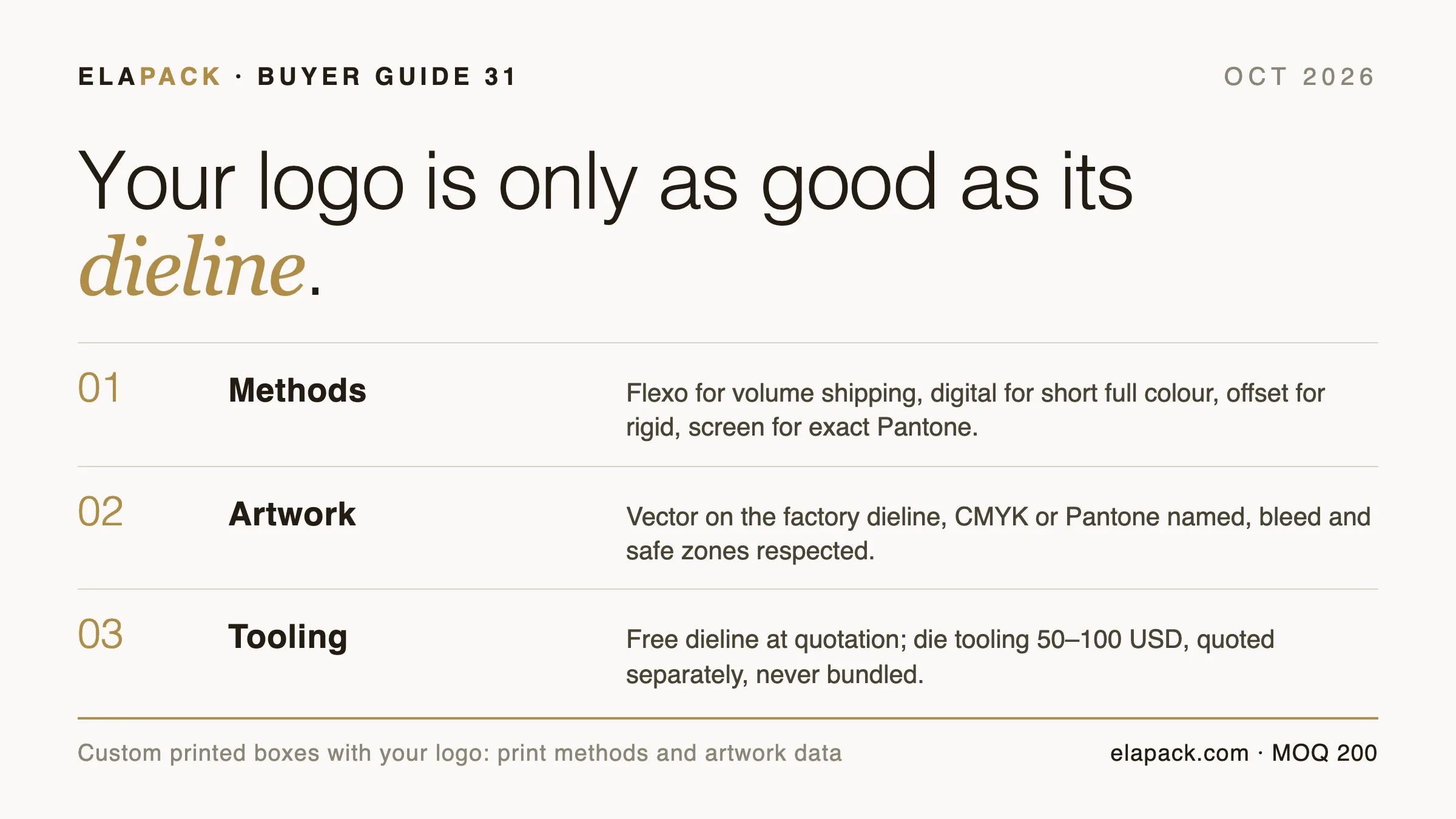
Quick answer: match method to run and material: flexo for 1–3 colour shipping boxes at volume, digital for short full-colour runs, offset/litho for rigid and premium cartons, screen print for Pantone-exact spot colour. Prepare artwork as vector on the factory's dieline, CMYK or Pantone named, bleed and safe zones respected — and expect die tooling at USD 50–100 when a new die is needed, quoted separately, never bundled silently.
Key facts at a glance
| Item | Data |
|---|---|
| Head words | custom printed boxes (1,900/month, KD 35), custom boxes with logo (1,900, KD 50) |
| Soft tails | custom mailer boxes with logo (320, KD 26), custom ring boxes with logo (40, KD 6) |
| Four methods | flexo, digital, offset/litho, screen print |
| Artwork non-negotiables | vector file, factory dieline, CMYK/Pantone named, bleed + safe zone |
| ELAPACK minimum order | 200 pieces, custom sizes included |
| Die tooling | USD 50–100 when a new die is needed, quoted separately |
| Samples | stock sample free (USD 20 shipping); custom sample USD 25 + USD 20, 3–5 days |
What the search data says

The head words sit at KD 35–50 — print-marketplace territory — but the category tails are soft: ring boxes with logo at KD 6, candle boxes with logo at KD 15, mailer boxes with logo at KD 26. The pattern repeats across this site's guides: generic print words are locked by marketplaces, product-specific logo words are open — which is why this guide ends at per-box-type practice, not generic print advice. The no-minimum word (390/month) belongs to the print-on-demand market and is quoted here only as market context.
The four print methods
| Method | Best at | Colour capability | As published |
|---|---|---|---|
| Flexography (flexo) | shipping boxes, volume runs | 1–3 colours, simple graphics and logos | CustomBoxesNow: a basic form of box printing, 1–3 colours, ideal for simple logos |
| Digital | short runs, proofs, full colour | full CMYK without plates | industry standard for short full-colour work |
| Offset / lithography (litho-lamination) | rigid boxes, premium cartons | high-resolution, full colour, sharp detail | Brown Packaging: the most popular method for rigid boxes |
| Screen print (silk-screen) | spot colour, Pantone-exact, textures | one colour per screen, exact Pantone | the standard for spot-colour logo work |
The rule the table hides: method follows substrate and run length more than quality — a flexo logo on a kraft mailer is correct printing, not cheap printing. For rigid boxes the wrap prints offset then laminates to greyboard — the construction detail the rigid box guide unpacks.
Artwork: what a factory actually needs
The four-step file flow published by Packaging Studio is the industry baseline: obtain the dieline template, design the artwork, position it on the dieline, export print-ready files. The failure modes BrillPack catalogues are the ones factories see daily: missing bleed, artwork outside safe zones, wrong colour mode. In practice:
| Requirement | Why | Common failure |
|---|---|---|
| Vector artwork (AI/PDF/EPS) | logo scales without edge softness | JPG logo pulled from a website |
| Factory's dieline as the base | print areas map to the real cut | artwork laid out on a guessed template |
| CMYK or named Pantone | colour is reproducible | RGB file with implied conversion |
| Bleed + safe zone honoured | die-cut tolerance does not clip the logo | logo 2 mm from the crease |
Send vector on the factory's dieline and 90% of print problems disappear before the press. ELAPACK draws the digital dieline free at quotation and accepts buyer-supplied vector files — the terms are set out in the die cutting and dielines guide.
Logo placement and size decisions
| Placement | Reads as | Constraints |
|---|---|---|
| Lid centre | formal, retail-front | the classic; keep clear of magnets and closures |
| Lid corner | quiet, premium | needs colour discipline across the run |
| Front face (mailer) | logistics-honest | competes with labels — plan the shipping label zone |
| Inside lid | the unboxing reveal | costs the same ink, buys the surprise — see the magnetic gift box guide |
| Base or spine | archive-grade, subtle | suits sets that stack or shelve |
One placement done large beats five placements done small — a logo is an identity mark, not wallpaper. Size follows the box's viewing distance: a mailer read at arm's length carries a smaller mark than a gift box opened on camera.
Print plus finish: where the budget goes
Printing puts the logo on; finishing changes how light hits it. Foil and emboss are finish decisions, not print decisions — the full comparison (embossing, foil, lamination, spot UV) with cost characterisations lives in the surface finishes comparison. The budget structure that works: one print method, at most one signature finish, both named in the quote. A quote that lists printing and finishing but no dieline or tooling line has not finished pricing your job.
Tooling arithmetic
| Cost item | ELAPACK figure | When it applies |
|---|---|---|
| Digital dieline drawing | free | every quotation |
| Die tooling | USD 50–100, quoted separately | only when a new die is genuinely needed |
| Setup for repeat orders | per quotation | reprints of a confirmed die are cheaper |
Tooling quoted separately and small is a feature, not an upsell — it means the factory prices the die honestly instead of hiding it in unit price across every re-order. The same logic governs minimums: at 200 pieces the setup amortises over a brand-sized run, which is the entire point of a brand-friendly MOQ.
Per-box-type practice
- Rigid boxes — offset wrap, logo foiled or screened on the lid; construction first: rigid box guide.
- Mailers — flexo or digital on E-flute, logo front-face, label zone planned; the mailer section of the rigid guide covers the decision.
- Gift boxes with closures — print to the closure system; magnetic builds in the magnetic guide, ribbon-tie programmes in the ribbon guide.
- Category boxes — ring boxes (sizes and inserts), candle boxes (ordering data) — the soft KD tails live at this level.
Bottom line
Choose the method by substrate and run, prepare vector artwork on the factory's dieline, place the logo once and large, and read every quote for the tooling line. Start a printed-box programme from the custom gift boxes collection or the magnetic closure gift box — free dieline at quotation, MOQ 200, and a custom sample in 3–5 days at USD 25 + USD 20 shipping via the quote request.