
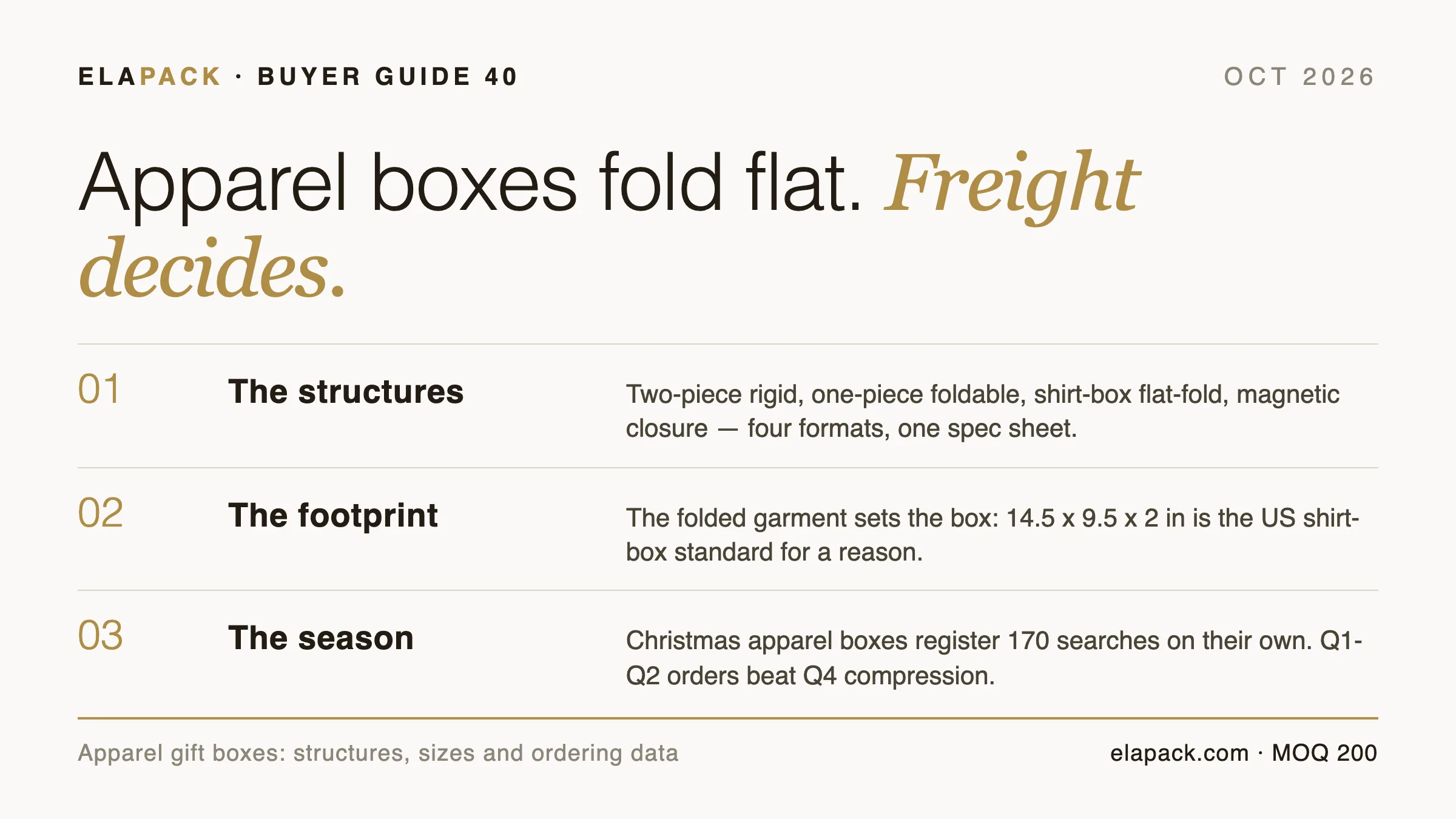
The standard US shirt-box size (14.5 x 9.5 x 2 in) and bulk pricing examples are as published in US retail supply listings (Amazon, Paper Mart, read 12 October 2026). This factory's ordering terms are its published trading terms.
This is the box side of fashion packaging. The bag side — garment bags, retail carry bags, poly alternatives — has its own page: [custom clothing and apparel packaging](https://elapack.com/news/custom-clothing-apparel-packaging-guide/). The two link up at the checkout counter: box inside, bag outside.
Quick answer: apparel gift boxes come in four structures — two-piece rigid, one-piece foldable, shirt-box flat-fold and magnetic closure — and the structural choice is mostly a freight and unboxing decision, not a strength decision. Standard US shirt-box footprint runs 14.5 x 9.5 x 2 in as listed in bulk retail supply; custom footprints start from your folded garment. Orders run from a 200-piece MOQ in 15-20 working days.
Holiday-shaped, wholesale-flavoured
Apparel box demand runs on the retail calendar — Christmas registers as its own line — and on wholesale re-ordering: boutiques and fashion e-commerce buy on season, not on launch. The buying guide that survives both cycles is the one that fixes structure and garment measurement rules once.
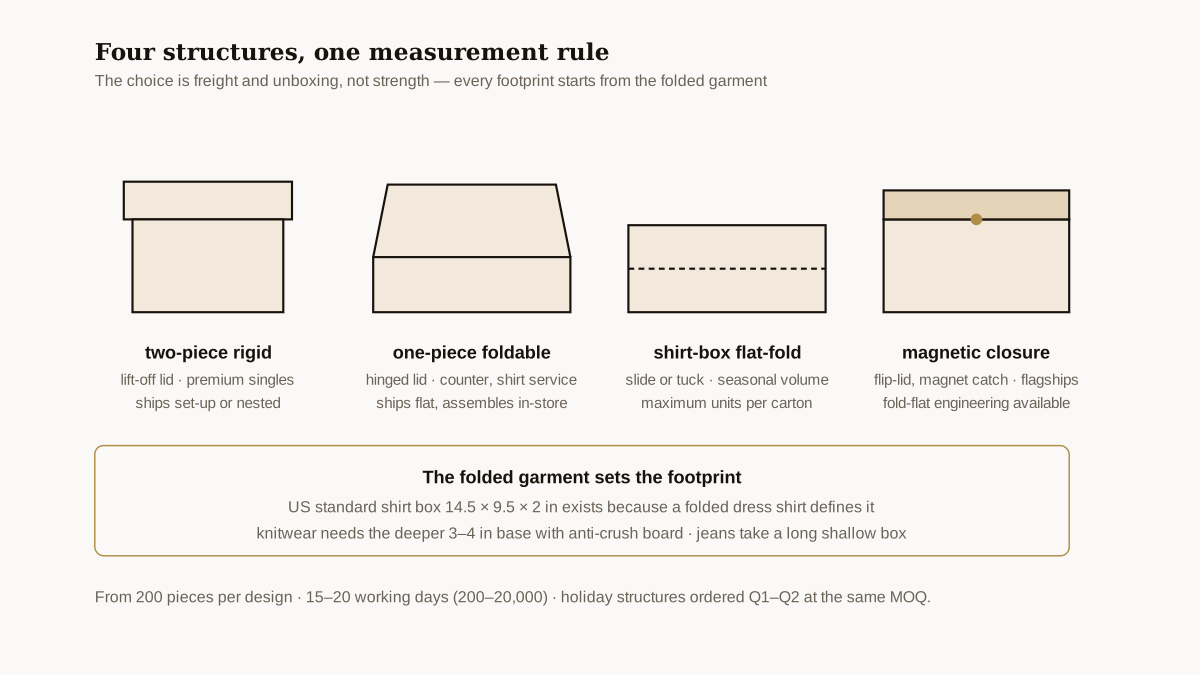
Fix the structure and the garment measurement rule once, then re-order on season — the box outlives the campaign.
Structures: what each format is for
| Structure | How it opens | Best for | Freight reality |
|---|---|---|---|
| Two-piece rigid (lid and base) | lift-off lid | premium single garments, gifting | ships set-up or nested; volumetric weight is the cost driver |
| One-piece foldable, hinged lid | folds out | retail counter, shirt service | ships flat, assembles in-store in seconds |
| Shirt-box flat-fold | slide or tuck | high-volume seasonal programs | the classic trade: maximum units per carton |
| Magnetic closure | flip-lid with magnet catch | flagship SKUs, subscription boxes | fold-flat engineering available; see the wholesale guide |
The engineering trade-offs (board grades, wrap, corner construction) are common to all rigid boxes and are covered in the rigid box guide and the magnetic structure guide; the apparel-specific decision is footprint and pack format.
Sizing: start from the folded garment
The one published anchor is the US standard shirt box at 14.5 x 9.5 x 2 inches, sold in 100-packs by retail suppliers (Amazon and Paper Mart listings, read 12 October 2026) — that footprint exists because a folded dress shirt defines it. Everything else in apparel is measured the same way:
| Garment | Measurement rule | Box implication |
|---|---|---|
| Shirts | folded to retail fold standard | standard footprint, 2 in depth |
| Knitwear | folded, not hung | deeper base, 3-4 in, anti-crush board |
| Jeans | tri-fold or flat roll | long shallow box; rigid keeps the stack shape |
| Accessories sets | garment + card + pouch | insert tray; see packaging inserts |
The rule: send the supplier your garment's folded dimensions (or the garment), and the box and insert get built around them — the same principle that governs our eyewear boxes, where folded frames set the footprint.
Finishing the box: what goes inside and around it
An apparel box rarely travels alone. The commercial pairing is tissue plus ribbon: custom tissue paper (weights and print data) folded over the garment, and printed ribbon as the bow closure on lid-and-base boxes. Window films on display boxes are a compliance variable for EU-bound programs — the PPWR guide explains which build elements grade cleanest.
Ordering data
| Line item | Terms |
|---|---|
| MOQ | 200 pieces per design, structures and sizes included |
| Production | 15-20 working days (200-20,000), 20-25 days (20,000-50,000), from sample approval and deposit |
| Stock sample | free, ships 2-3 days, plus USD 20 courier |
| Custom sample | USD 25 + USD 20 shipping, 3-5 days from confirmed artwork |
| Cutting die | USD 50-100 one-off per design; dieline drawn free |
| Payment and freight | T/T or PayPal; air or sea from Shanghai or Shenzhen |
Seasonal note: christmas-flavoured demand means Q4 production windows compress — the counter-seasonal move is ordering holiday structures in Q1-Q2 at the same MOQ, which is also when freight is cheapest.
Bottom line
Pick the structure by where the box is opened (counter vs unboxing vs shipping), size it from the folded garment, and let the flat-fold formats carry the high-volume seasons. The wholesale-tier logic — how quantity, tooling and freight interact — is laid out in the magnetic wholesale guide and applies line for line to apparel.
Spec an apparel box program: send folded garment dimensions and target quantity through the contact page. Pair with the bag side via the apparel packaging guide, or browse the custom gift box collection for starting structures.