
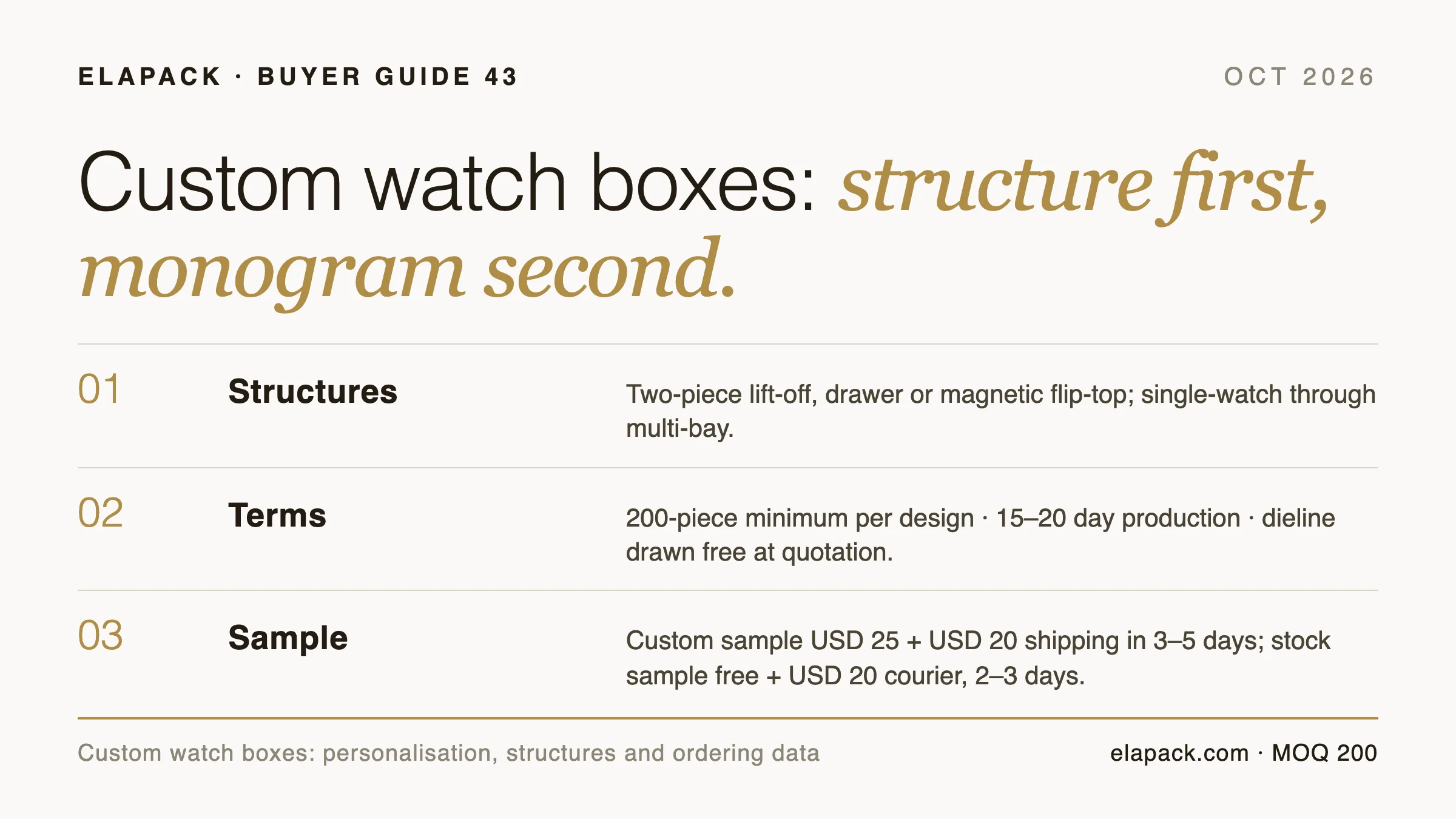
Ordering terms below are ELAPACK quote-sheet terms. Supplier practices and comparator terms are described as published by the named suppliers, read 14 October 2026. Community sentiment is summarised from public watch-community discussions, read 14 October 2026. We make and supply custom watch boxes, so read this as a manufacturer's data sheet rather than a neutral review.
For the jewellery-box family across ring, necklace and gift formats, see the custom jewellery boxes guide; this page stays on the watch programme.
Quick answer. A custom watch box is a rigid presentation box with a fitted pillow that holds the watch upright and still — single-watch presentation pieces through multi-bay boxes for sets and collectors. Three structures cover the demand: two-piece lift-off, drawer and magnetic flip-top, in art-paper, textured or faux-leather wraps. Personalisation on this line runs in foil, embossing or print; engraved wooden boxes are a different industry. Branded runs start at 200 pieces per design, dieline free at quotation, custom sample USD 25 plus USD 20 shipping, 15–20 day production.
1. What a branded watch box programme covers
Three buyer groups order these boxes. Watch brands and microbrands box the watch itself — counter presentation, e-commerce parcels, the box-and-papers that follow a piece at resale. Strap makers box straps and strap-and-watch sets. Gift and corporate programmes order monogrammed presentation boxes for retirement, graduation and wedding-party gifting — this is where the personalised and monogrammed demand lands when it arrives as a business order rather than a one-off retail purchase.
The watch-buying community holds a settled opinion worth reading before the budget line. Across recurring microbrand threads, buyers argue that large, high-cost boxes waste money that belongs in the watch, and favour low-profile boxes that keep shipping prices down — "big into low profile boxes that keep shipping prices down and costs put into the watches" is the recurring phrasing. The counterpoint, that original box and papers matter at resale, is the reason the box survives as a programme at all. Both positions land on the same specification: keep the profile low and the presentation intact.
What the box then does is fixed: present the piece at the counter, hold it upright and still in transit, protect it through gifting and shipping, and carry the brand face on every surface.
Takeaway: the community that buys watches asks for low profile first — the presentation has to earn its height.
2. Three structures: lift-off lid, drawer, magnetic flip-top
Table 1 — the three structures at a glance.
| Structure | How it works | Works hardest at |
|---|---|---|
| Two-piece lift-off | lid lifts clear of a base | counter presentation, gifting |
| Drawer | tray slides from a sleeve | strap-and-watch sets, premium unboxing |
| Magnetic flip-top | hinged lid closes flat | e-commerce retail, parcel post |
The lift-off is the classic single-watch presentation piece: the lid comes clear away, the base carries the pillow, and the unboxing is a two-hand moment built for counters and gifting. The drawer suits sets — the tray carries the fitted pillow while the sleeve carries the finish, so a watch-plus-strap programme presents as one piece. The magnetic flip-top closes flat and opens one-handed at a counter, and the closure holds through parcel handling; the construction logic behind magnetic lids is covered in the magnetic gift boxes guide.
Layouts run from one-watch presentation boxes to multi-watch boxes with individually pillowed bays. For size class, stock comparators as published by Westpack (read 14 October 2026): single lacquered watch gift boxes at 9 × 9 × 8.5 cm, watch-and-bracelet combinations at 13 × 13 × 10.5 cm — a single-watch box is a small object, and the structure list above decides how that small object opens, not how big it gets.
Takeaway: structure follows where the box works hardest — counter, unboxing or parcel.
3. The insert: watch pillows and bays
The pillow is the part that fits the watch. Fitted pillows, velvet or satin covered, hold each timepiece upright and still — the same insert craft that runs in our ring boxes, with pillow materials and colours specified to the programme. A watch laid loose in a lined box rolls in transit and presents at an angle; the pillow fixes head and strap so the piece sits the way it is worn.
Multi-watch boxes get individually pillowed bays, so a two-watch gift pair or a six-watch collector set holds each piece independently — one bay per watch, each cut to the same specification.
The specification inputs are the watch's own numbers: case dimensions, strap, and piece count per box. Those three settle the pillow cut and the bay spacing at dieline stage, which is why a watch-box quotation starts from watch dimensions rather than box dimensions. For the wider insert logic across box families — foam, moulded pulp, board and textile — the packaging inserts guide compares the materials.
Takeaway: the pillow is the fit decision — quote from the watch's dimensions, not the box's.
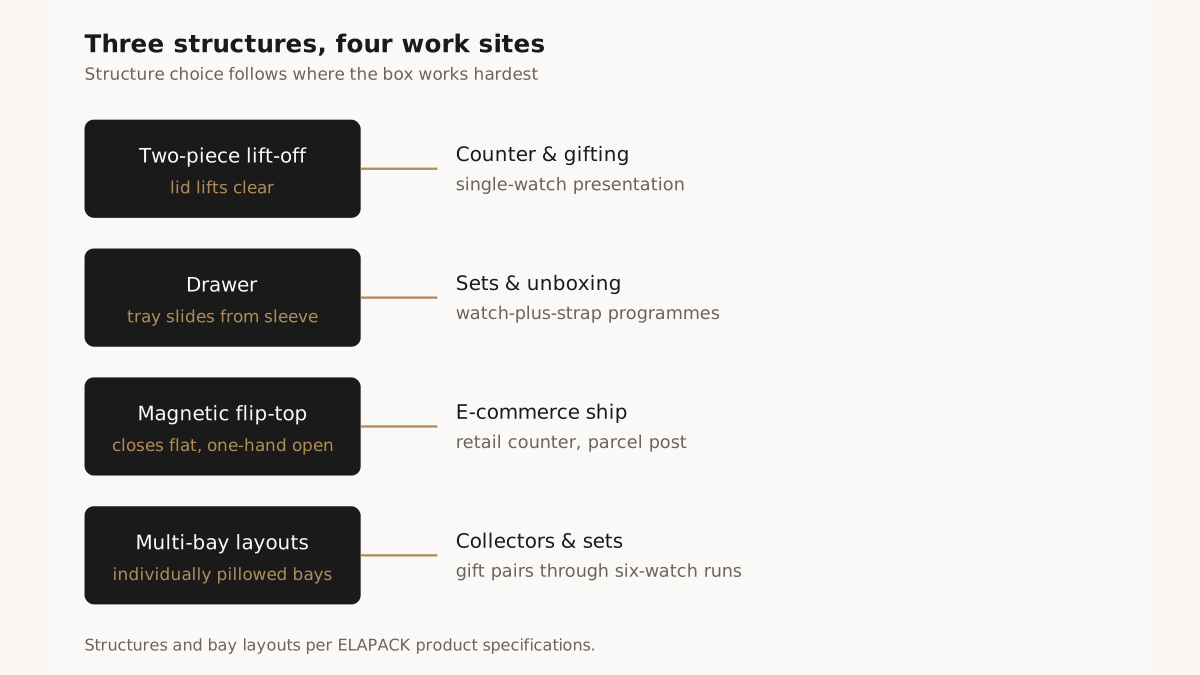
Fig. 1 — Structure-to-context mapping: the three structures and the multi-bay layout, and where each one works.
4. Wraps, finishes and personalisation
The wrap is the brand surface. Three wrap families spec to the programme: matte art paper for full-print branding, textured wraps for a tactile finish under foil, and faux leather for the gift and counter end. Board construction is the same craft as our jewellery boxes — greyboard at 1.5 mm through 3.0 mm by box size, board cost running roughly 8–25 % of the box depending on size, structure and finishing (ELAPACK process data, for reference only). Surface finishes layer on top: matte or gloss lamination, foil stamping, embossing and spot UV — the surface finishes comparison breaks down the cost and appearance trade-offs.
Personalisation on this line runs in three routes. A foil monogram — initials stamped in foil on the wrap — is the gifting route for corporate and wedding-party programmes. An embossed or debossed brand mark reads blind, without colour, and carries the jewellery-counter register. Full print turns the whole wrap into the brand face, edge to edge.
One boundary line: the retail monogrammed-watch-box market runs on engraved wood and leather, and that supply is a different industry — joinery and leather goods, not print-and-board packaging. A monogram does not require engraving. Foil initials on a matte wrap are the standard route when the order is a branded run rather than a one-off retail gift, and this page stays on the print-and-board side of that line.
After the box opens, matched velvet pouches carry the watch through storage and travel — the after-sale programme runs on the same colour and logo specification.
Takeaway: monograms on this line run in foil, emboss or print — engraved wood is another industry.
5. Sizing the box to the watch — and the parcel
Sizing starts at quotation, and the inputs are the watch's numbers plus the piece count. The dieline is drawn free at quotation to the confirmed sizes: bay width follows case diameter plus strap, and box height follows pillow depth plus lid clearance. Nothing in that chain needs a standard box size, because the watch is the standard.
The parcel is the second number. Couriers bill by the greater of actual and volumetric weight — standard published practice across carriers — so box height converts directly into freight cost per piece. This is the arithmetic behind the community's low-profile preference: a single-watch lift-off at single-figure centimetres of height ships as a small parcel, and a tall lacquered chest does not. For gifting programmes on a calendar, the packaging timeline guide works back from the giving date to order and production dates.
Takeaway: two numbers size the box — the watch, and the parcel it ships in.
6. Ordering data
Table 2 — quote-sheet terms, custom watch boxes.
| Item | Term |
|---|---|
| MOQ | 200 pieces per design |
| Dieline | Free, drawn at quotation |
| Cutting die | USD 50–100, one-time |
| Custom sample | USD 25 + USD 20 shipping, 3–5 days |
| Stock sample | Free + USD 20 shipping, 2–3 days |
| Lead time, 200–20,000 pcs | 15–20 days |
| Payment | T/T or PayPal |
Watch boxes are die-cut rigid products, so the cutting-die line applies to a first order as a one-time cost. Supplier photography for this line is still in progress — a stock sample (free plus USD 20 shipping, 2–3 days) judges the board and wrap in hand before any artwork decision, and a custom sample (USD 25 plus USD 20 shipping, 3–5 days) settles wrap, colour and personalisation before the run. What a packaging sample should show, and what it costs across formats, is covered in the packaging samples guide.
Table 3 — comparator terms, as published by each supplier (read 14 October 2026).
| Supplier | Published term |
|---|---|
| Westpack | logo-customised watch boxes from MOQ 250 (single styles) / 300 (watch-and-bracelet combos); stock boxes no MOQ |
| Allure Pack | logo plate fees from USD 75; box-and-pouch sets from USD 89 |
These are each supplier's own published terms, quoted for comparison only; ELAPACK terms are Table 2 and run from 200 pieces per design. To request a quote: watch dimensions, piece count and bay count, wrap family, personalisation artwork, and the target ship date.
Takeaway: 200 pieces per design is the entry point; the dieline and a USD 25 sample settle the spec before the run.
Bottom line. Three structures carry the demand — lift-off lids for counters and gifting, drawers for sets, magnetic flip-tops for parcels — with fitted pillows sizing from the watch itself and wraps from art paper to faux leather. Personalisation on the print-and-board line runs in foil, emboss and print; engraved wooden boxes belong to a different industry. Branded runs start at 200 pieces per design, dieline free at quotation, custom sample USD 25 plus USD 20 shipping, 15–20 day production.