This guide combines a buyer workflow with explicitly attributed historical survey examples. The workflow is an editorial recommendation, not a proven spending formula. Survey responses are not ELAPACK customer results, controlled experiments or guarantees of repeat purchasing.
Quick answer: resolve product protection and fit, review the opening sequence, then specify information and decoration. Evaluate those choices using actual shipment, cost and customer data rather than assuming attractive packaging causes loyalty or social sharing.
Separate the layers in the brief
The shipping outer, presentation structure, insert and printed components have different roles. State which component protects the product in transit, which retains it, how the customer removes it, and where instructions or offers appear. A gift box may still need a separate transit outer.
The rigid boxes guide covers structure; the inserts guide covers retention. Quote the complete pack and any required testing rather than treating a finish or closure as proof of shipping suitability.
What a consumer survey can tell you
Ryder's 2025 E-commerce Consumer Study reports a March 2025 survey of 1,376 US online shoppers. In its premium-unboxing question, 52% selected that the experience makes the brand seem upscale and 31% that it makes them want to purchase again. These are different self-reported responses, not measured conversion rates or evidence that one packaging layer caused a purchase.
The Macfarlane 2025 survey results provide another consumer-feedback source. Different questions, samples and reporting periods should not be pooled into one damage rate or used to forecast an ELAPACK programme's return on investment.
Use external surveys to develop questions for your own customers. Do not turn historical sentiment into a universal budget order, a promise of near-zero damage or a percentage improvement in retention.
Protection and fit: agree observable checks
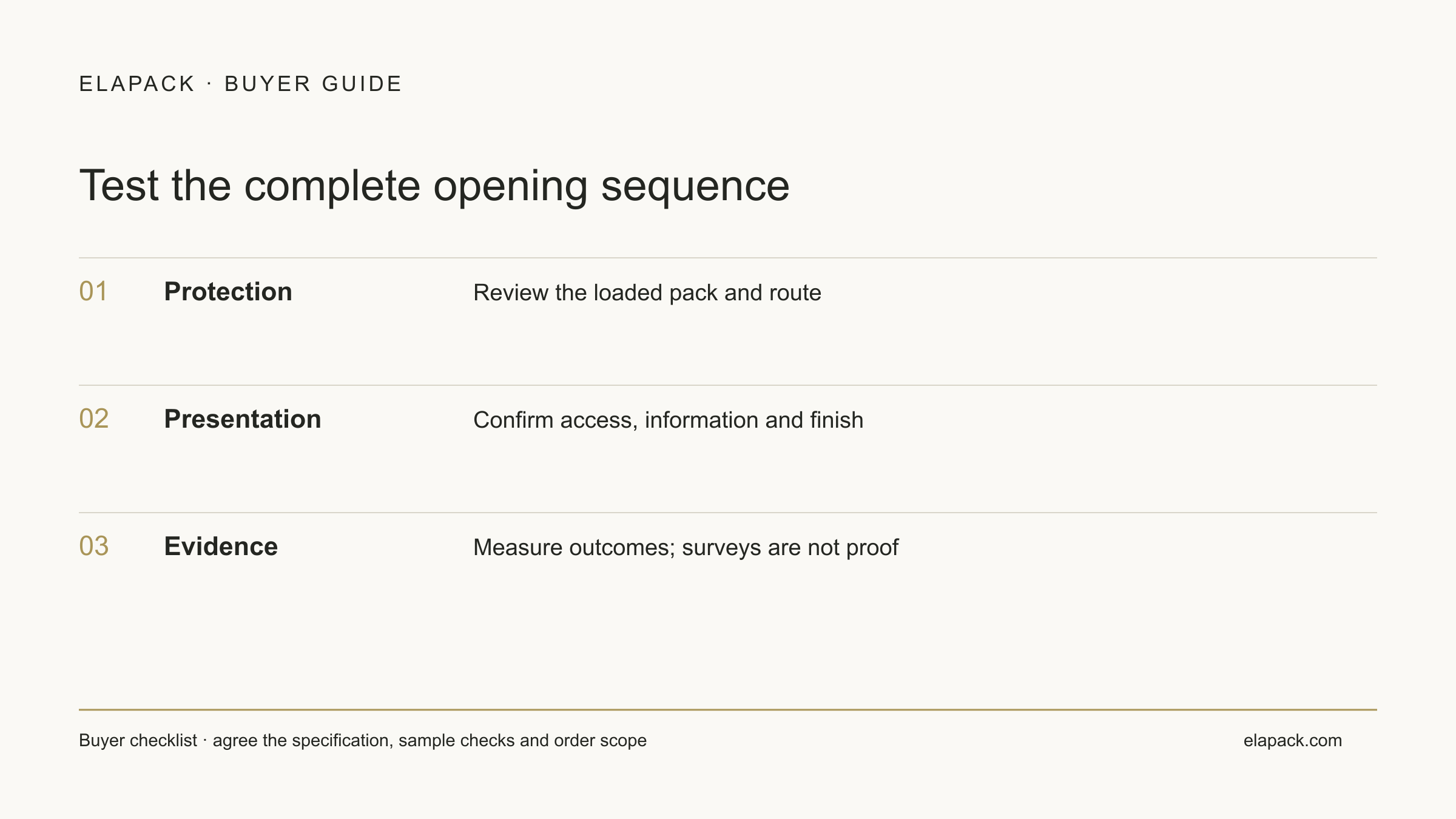
Record product dimensions and weight, surface sensitivity, insert geometry and the intended distribution route. Review the loaded sample and specify the transport outer. Agree route-appropriate tests and acceptance criteria where needed; a successful visual review is not a drop-test result.
Right-sizing must account for protective components and removal access, not just the smallest external box. Compare the whole pack. A change that removes void fill can also change restraint or impact exposure and needs review.
Opening: test the sequence with the contents
A lift-off lid, magnetic hinge, ribbon tie and drawer require different motions. Check access, closure resistance and product removal on the actual proposal. Avoid assuming one-handed use, unlimited reuse or a better customer response from the format name.
Review the sequence from transit outer to product removal. Ask whether the user can identify where to open, lift the item without damaging it and find any needed care information. The magnetic and ribbon comparison discusses the alternative closure tasks.
Information and decoration
Decide what the customer needs to read: identification, care, assembly, disposal or an optional offer. Specify card size and position alongside the insert and box so that instructions remain accessible.
Select printing and finishes for the artwork and actual construction. Compare component costs and sample appearance rather than assuming a card is always cheaper than a board change or that one printed surface has the greatest return per dollar. The surface finishes guide covers related selection questions.
Environmental wording requires separate evidence. Recycled content, recyclability, reuse and environmental impact are different claims; do not infer them from colour, fabric name or a general survey preference. Check materials, collection conditions and applicable rules before approving disposal copy. The PPWR guide covers the related EU questions.
A practical review sequence
| Review | Questions | Evidence for the decision |
|---|---|---|
| Product and route | What can be damaged, and how will the pack travel? | Product details, loaded sample and agreed route tests |
| Fit and access | Is the item retained and removable? | Approved drawing and sample observations |
| Information | Can the user find required instructions? | Artwork and task review |
| Decoration | Does the finish meet the brief within budget? | Matched quotation and physical reference |
This sequence is a proposed workflow, not a finding that the surveys measured the return of each layer. The multi-component quote guide covers comparable component pricing.
Measure actual outcomes
Track damage and returns with a shipment denominator, delivered packaging cost, assembly effort and relevant customer feedback. If testing retention or sharing, define the customer cohort, observation period and attribution method. A social post count or stated intent is not a purchase outcome.
Evaluate changes against a comparable baseline and account for product mix, channel and seasonal differences. Read damage and total cost together; heavier board, tighter fit or more decoration does not guarantee a particular outcome.
ELAPACK's MOQ is 200 pieces. Confirm size, colour and artwork allocation in the quotation; this does not mean every variant can be split freely. For a complete set, each component has a 200-piece minimum. Custom samples are USD 30 plus USD 25 shipping, with a 3–5 day sample-making timeframe. Stock samples are free with USD 25 shipping and a stated delivery timeframe of 4–7 days. Production is typically 15–20 days after sample approval and payment receipt; confirm by order.
Contact ELAPACK with the product, packing sequence, artwork and destination. Agree the proposed components, sample scope and verification steps for the project.