
Stock sizes, prices and MOQ figures from named suppliers are industry references as published on their pages, cited inline; they are not ELAPACK stock or specifications. ELAPACK’s confirmed trade terms — MOQ 200 pieces, custom sample USD 30 plus USD 25 shipping with 3–5 day sample making, production typically 15–20 days after sample approval and payment receipt, free digital dieline previews — apply as stated.
White jewelry boxes are the default of the trade — the box a ring or pendant is expected to arrive in when nothing else is specified. That default status is exactly why the purchase decision is harder than it looks: the market splits into stock cases bought by the hundred and custom runs bought by the thousand, and the two routes do not even describe “white” the same way. The general box-choice framework — structure, insert, finish, size — is covered in our guide to choosing a custom jewelry box; this page is the white-specific layer on top of it.
Quick answer: stock white boxes come in standard sizes by the case, fast; custom white boxes from MOQ 200 at ELAPACK fit the jewelry, carry your logo in the wrap, and run typically 15–20 days after sample approval. The decision runs through size fit, shade tolerance, insert needs and dates — the sections below.
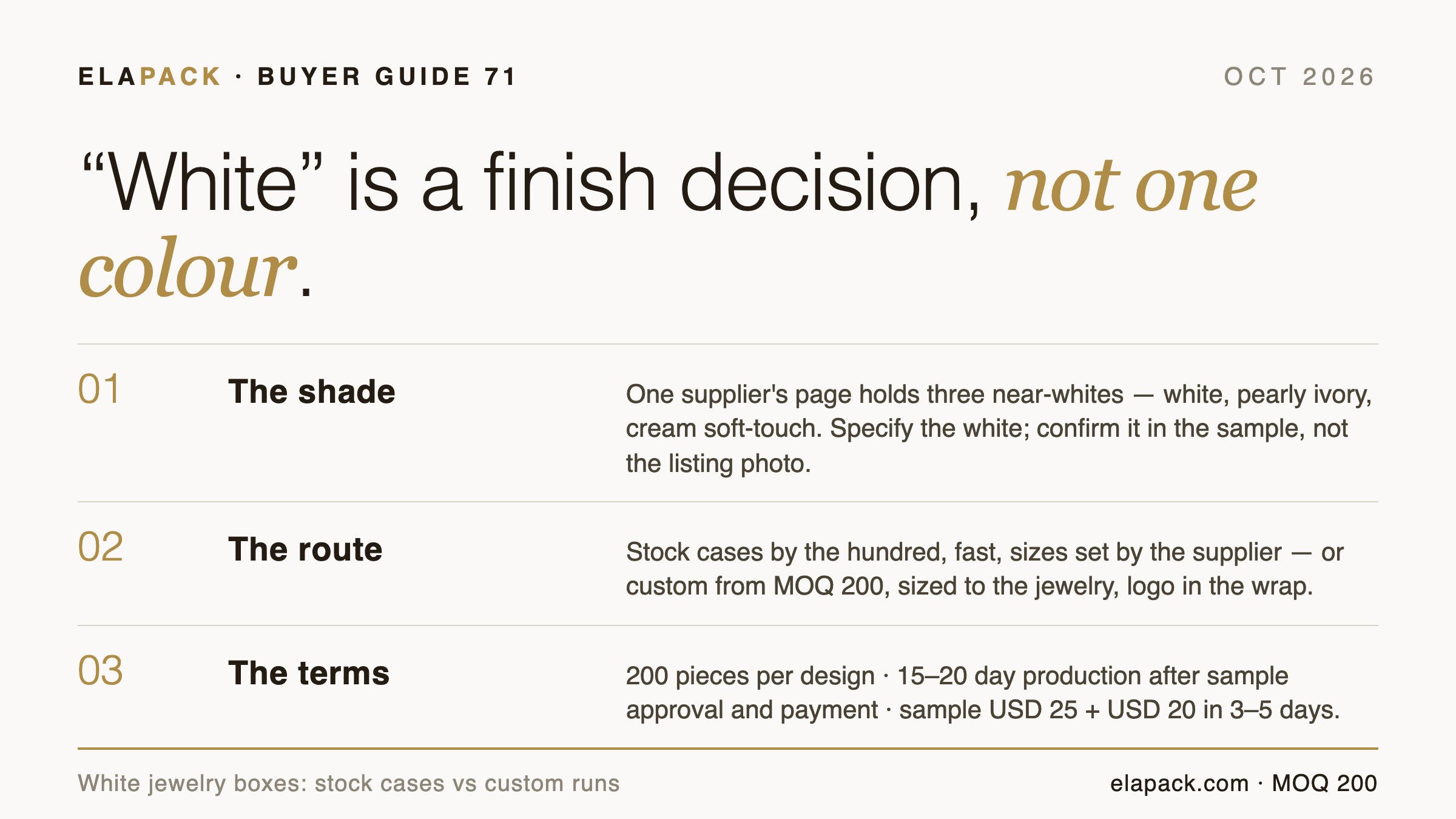
“White” is a finish decision, not one colour
Before comparing prices, compare what suppliers actually mean by white. On one supplier’s page alone, the near-white family runs from structured white cardboard with white foam, through pearly ivory with cream foam, to cream soft-touch board with cream velour — three visibly different boxes, all filed under “white jewelry boxes.” Gloss white, matte white and embossed swirl finishes sit on top of that: JewelrySupply’s stock line, for instance, is a white swirl embossed board, a texture choice as much as a colour one.
Two consequences follow for a buyer.
First, shade drift is a real tolerance question when boxes come from different suppliers or restocks — the discipline is the same one our packaging colour tolerance guide sets out: fix a reference and judge everything against it. Second, the finish changes the price tier and the handling story — gloss shows fingerprints differently than matte, soft-touch costs more, and edge white shows board colour at the seam if the wrap is cut short. None of these are reasons to avoid white; they are reasons to specify which white, and to confirm it in the approved sample rather than in the listing photo.
ELAPACK’s enquiry route reflects this: the surface appearance and shell material are fields you confirm in the quotation and the approved sample, not assumptions carried by the word “white.”
The stock route: standard sizes, case quantities
The stock route is a genuine commodity, well served and fast.
Packaging Source’s white line is the canonical shape of it: rigid two-piece construction with a lift-off lid, non-tarnishing cotton fill, nine sizes from compact ring boxes to large necklace-set boxes, all sold by the case at wholesale pricing and made in the USA for retail jewelry stores. JewelrySupply sells its white swirl embossed boxes in six sizes, individually or in cases of 100. Gems on Display publishes a cotton-filled size chart that includes an 8 × 2 × 0.75 in. gloss white format for long necklaces and chains; Amazon’s listings carry the small end, like a 2.5 × 1.5 × 1 in. two-piece box for studs and pins.
Buying by the case also buys someone else’s size decisions. The fit question a bulk buyer’s guide like Action Packaging’s puts first — box dimensions against interior fit, padding, closure — is answered in advance on a stock box, and answered generically. A ring seats differently in a 49 mm slot and a 44 mm one; stock sizes are sized to stock jewelry.
The stock route wins when: standard sizes fit the pieces; volume per size is small or unknown; the date is near; and branding is applied elsewhere — a label, a sleeve, a ribbon. Etsy’s 100-piece logo packs and Westpack’s free branding on selected stock styles both sit in this space: a logo on a stock box, without a production run behind it.
The custom route: what changes from MOQ 200
The custom route starts where the stock route’s answers run out: exact internal fit, an exact shade of white, a logo in the wrap rather than on it, and a structure chosen for the piece.
The MOQ ladder in the market runs roughly: stock cases from 100 pieces (JewelrySupply, Etsy), logo-decorated stock from the same hundreds, full custom from the high hundreds — Velvet Packaging’s buyer guide puts typical custom MOQs at 300–500 pieces per design, size or colour, and Richpack publishes full custom at 500 with selected US-stocked styles at 100. ELAPACK’s custom white boxes start at 200 pieces — below the usual full-custom band, with the full custom scope: shell material and finish, lining and insert, closure and logo method, all confirmed against an approved sample.
What that buys, concretely: a box sized to the jewelry rather than to a size chart (the enquiry lists jewelry dimensions, item count, preferred opening and artwork); a fitted insert instead of a generic cotton bed; the white you specified, consistent across restocks; and the logo printed, foil-stamped or embossed in the wrap from the first run.
The custom route also runs on a real clock: a 3–5 day custom sample, approval, then production typically 15–20 days after sample approval and payment receipt. Stock ships when the warehouse does. That date difference — not price alone — decides many white-box purchases, which is why it closes this guide’s checklist. To build out the programme around the box — pouches, cards, sets — the custom jewelry packaging guide is the umbrella reference.
Inside the box: cotton, foam and velvet
The lining is what the jewelry actually touches, and the routes differ here too.
Stock white boxes standardize on cotton fill — Packaging Source specifies non-tarnishing cotton as its interior, and it is the industry’s default bed for rings and studs. It is a good default, with one discipline our jewelry box inserts guide covers in depth: a lining’s name is not evidence of chemical compatibility, and any anti-tarnish requirement needs a specified material and applicable evidence, not a label. “Non-tarnishing” on a stock listing is that supplier’s statement about its cotton.
Custom opens the lining menu. Westpack’s insert range runs foam, velour, eco inserts, jewel wadding and lid pads; ELAPACK’s white box pairs a rigid shell with a velvet-lined cushion, with shell, lining and insert confirmed as three separate fields in the quotation and sample. The choice follows the piece: cotton and foam bed loose pieces economically; velvet cushions and shaped cavities present a single piece deliberately; wadding and pads fill lid space and stop rattle in multi-piece sets.
The specification discipline is the same one the inserts guide teaches: quote the box, the insert and the jewelry as three matched fields — a slot depth that fits someone else’s ring is not a spec for yours. Cards belong in the same three-field quote when pieces sell displayed rather than boxed — custom earring cards covers sizing, slots and ordering data for the common case.
Logo on a white surface
White is both the easiest ground to print on and an unforgiving one to finish on, and the logo method should be chosen for it.
Westpack’s custom page frames the comparison correctly for stock-adjacent printing: print area, logo position, foil colour options and minimum order quantity are the four fields to compare. On white specifically: metallic foils (gold, silver, rose gold) carry high contrast and a premium read; blind deboss gives a subtle, tone-on-tone mark that disappears from a distance — elegant up close, invisible on a shelf; full-colour print reproduces logos freely but sits on the surface rather than in the board.
White surfaces also make handling legible — the practical answer is to settle coating (gloss, matte, soft-touch) and confirm edge and seam behaviour in the approved sample, rather than trusting finish names in a catalogue. The question to put to any supplier, stock or custom, is the same: show me the logo method on the actual white, at the actual size.
A short decision checklist
Five questions separate the routes in one pass:
| Question | Points to stock | Points to custom |
|---|---|---|
| Do standard sizes fit the pieces? | Yes, typical rings/studs/pendants | No — multi-piece sets, unusual dimensions, fitted presentation |
| How exact must “white” be? | Any near-white works | A specified shade/finish, consistent across restocks |
| Is the logo the brand? | Label/sleeve/ribbon suffices | Logo in the wrap, foil or emboss, from the first run |
| Volumes per size? | Hundreds, mixed, uncertain | 200+ per design, steady restocks |
| The date? | Needed now | 3–5 day sample + 15–20 day production fits |
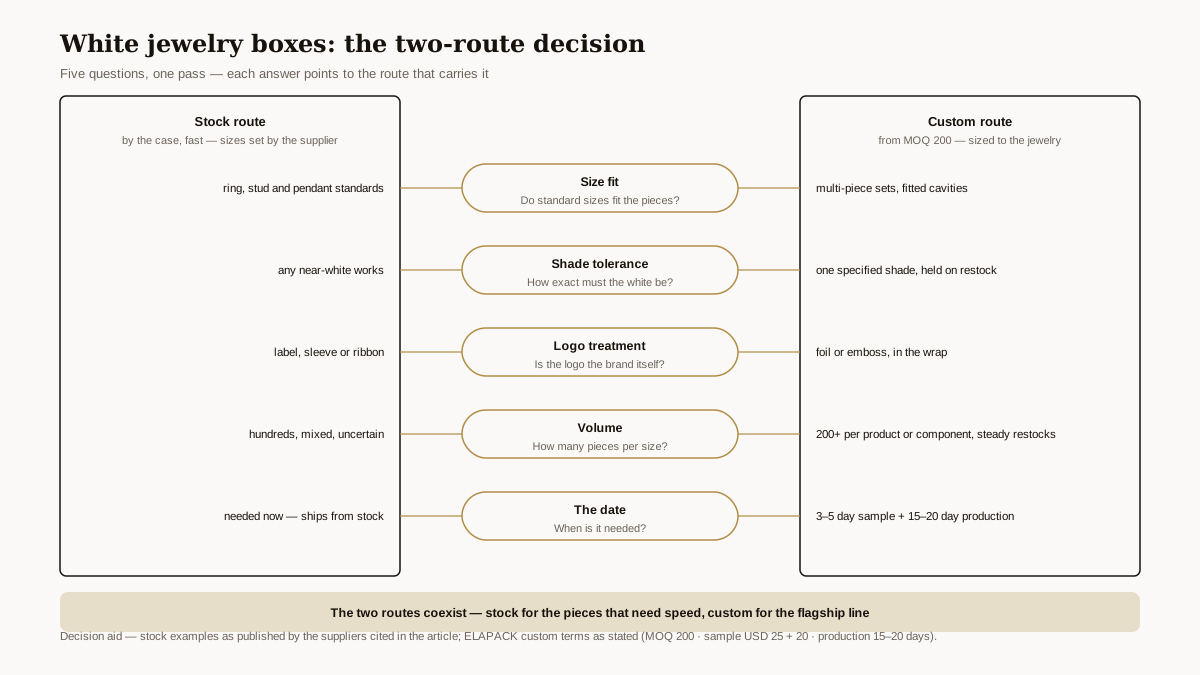
Where the answers split across rows, buy stock for the pieces that need speed and custom for the flagship line — the two routes coexist in most jewelry programmes. For the custom side, send the jewelry dimensions, item count, preferred opening and artwork, and the specification comes back with the quote and the sample plan.
Questions buyers ask about white jewelry boxes
What sizes do white jewelry boxes come in? Stock lines span ring minis to necklace sets — one supplier lists nine sizes; published examples run from 2.5 × 1.5 × 1 in. studs boxes to 8 × 2 × 0.75 in. chain boxes, in cases of 100. Custom boxes are sized to your jewelry dimensions instead — for rings specifically, the custom ring boxes guide matches insert styles to the collection.
Can I buy white boxes with my logo? Yes, three ways: logo-decorated stock (Etsy’s 100-piece logo packs; Westpack’s free branding on selected styles), or a custom run with the logo printed, foil-stamped or embossed in the wrap from MOQ 200 at ELAPACK.
What MOQ should I expect for custom white jewelry boxes? ELAPACK starts custom at 200 pieces. Published industry guides put typical full-custom MOQs at 300–500 per design, size or colour; some factories quote 500 for full custom with lower minimums only on stocked styles.
Cotton fill or velvet lining? Cotton is the stock standard and an economical bed for loose pieces; velvet and shaped inserts present single pieces deliberately. Any anti-tarnish requirement needs a specified material and evidence — a lining’s name is not a claim.
How long do custom white boxes take? At ELAPACK: a 3–5 day custom sample, then production typically 15–20 days after sample approval and payment receipt. Stock boxes ship per the supplier’s listing.
Specify the white, then the box. Send the jewelry dimensions, the item count, the preferred opening and the artwork, and the quotation comes back with shell material, finish, lining and insert as separate fields — confirmed in a custom sample at USD 30 plus USD 25 shipping in 3–5 days, with production typically 15–20 days after sample approval and payment receipt. Send the jewelry dimensions · custom white jewelry boxes.